Thursday, September 29, 2016

Mt. Herzl Schedule for Shimon Peres Funeral

Image result for Peres
Mt. Herzl Schedule for Shimon Peres Funeral 
Will be covered live  on all TV Israeli  Channels ( Best coverage will be Arutz 2 available on line)
http://reshet.tv/news_n/heb/news/news2live/

Farewell Ceremony for the 9th President of the State of Israel, the Late Shimon Peres

Friday, 30 September 2016

Mt. Herzl, Jerusalem

Master of Ceremonies – Gilad Adin

09:00 – Processional of Heads of State and Delegations from abroad

09:30 – Entrance of the President of the State of Israel Reuven (Rubi) Rivlin, Prime Minister Benjamin Netanyahu, Speaker of the Knesset Yuli Edelstein and the President of the Supreme Court, Justice Miriam Naor

        Announcement of the entrance of the coffin
        Opening Remarks – Gilad Adin

Eulogies:

   President of the State of Israel - Reuven (Rubi) Rivlin
   Prime Minister Benjamin Netanyahu
   Speaker of the Knesset – Yuli Edelstein
   Former President of the United States of America – William J Clinton
   Song by David D’Or – “Avinu Malkeinu”
   Author and Friend of Shimon Peres – Amos Oz
   Prof. Tsvia Walden
   Yoni Peres
   Nehemia ‘Chemi’ Peres
President of the United States of America – Barack Obama

        Kaddish
        Entrance of the Honor Guard and carrying of the coffin

11:15

– Estimated Finish

The family and world leaders will follow the coffin

Interment Ceremony

11:45 – Beginning of the interment ceremony (Estimated time)

        Arrival at the gravesite
        Lowering of the coffin into the grave
        Prayers
        Placing of the wreaths

   State of Israel wreath
   Government of Israel wreath
   Knesset wreath
   Supreme Court wreath
   Minister of Defense wreath
   Leader of the Opposition wreath
   World Zionist Organization wreath
   Jewish Agency wreath
   Israel Defense Force wreath
Israel Police wreath
Diplomatic Corps wreath
City of Jerusalem wreath
Peres Center for Peace wreath
Family wreath

After the dispersion of the delegations it will be possible to lay additional wreaths

Demographic and Decisions : Projecting The Jewish Vote in the US 2016 Elections

Demographic and Decisions : Projecting The Jewish Vote in the US 2016 Elections  


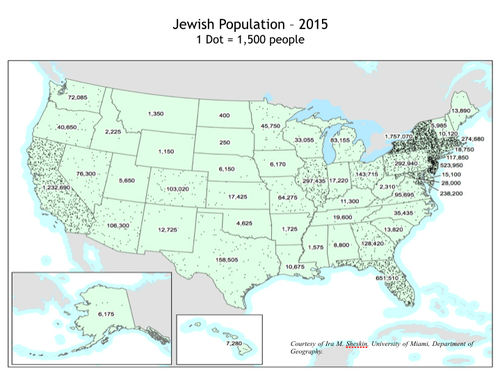
Click photo to download. Caption: A map of the Jewish population in America as of 2015. Credit: Courtesy of Dr. Ira Sheskin, University of Miami Department of Geography.


When it comes to projecting the Jewish vote in 2016, understanding demographics might lend some semblance of sanity to an election that most observers would compare to a roller coaster ride.

How Jews vote and why it matters

While Jews represent just 2 percent of the American population, surveys indicate that more than 90 percent of Jews who are registered to vote make it to the polls, compared to 54 percent of all Americans. Additionally, in 2013, 70 percent of U.S. Jews were living in New York, California, Florida, New Jersey, Illinois, and Pennsylvania—states whose combined 167 electoral votes make up more than half of the 270 electoral votes a presidential candidate needs to win the election.

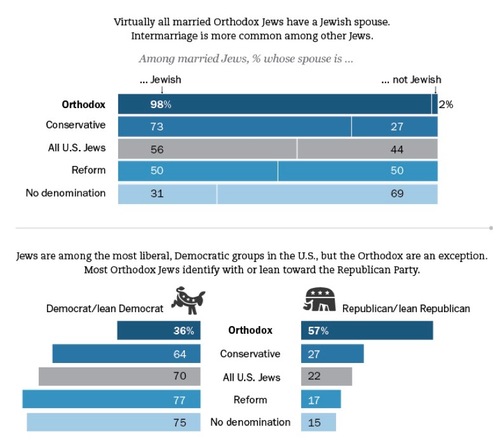
In 2013, the Pew Research Center’s “Portrait of Jewish Americans” survey showed that 78.2 percent of Jewish voters were Democrats, compared to 49 percent of the general American public. One exception, however, is Orthodox Jews. The Pew study said that 57 percent of Orthodox Jews identify or lean Republican, while 36 percent identify or lean Democrat. But Orthodox Jews represent “a very small part of the Jewish population, just 10 percent,” noted Dr. Steven M. Cohen, a research professor of Jewish social policy at Hebrew Union College - Jewish Institute of Religion (HUC-JIR).

Other Jewish groups likely leaning Republican are what Cohen calls “ethnic Jews”—those who are more “culturally conservative,” including immigrant Russian-speaking Jews, who “see a conservative political philosophy as most opposed to the government that oppressed them for decades.” 

When did U.S. Jews become liberal?

While today’s American Jews lean overwhelmingly Democrat, that wasn’t always the case. 

“In the late 19th century, from roughly 1864 until roughly 1916, American Jews voted Republican in overwhelming numbers. We don’t have a lot of data to substantiate that…but what we do know allows us to make a judgment call,” said Dr. Steven Windmueller, a demographer from Hebrew Union College’s Zelikow School of Jewish Nonprofit Management.

Dr. Ira Sheskin, a demographer at the Sue and Leonard Miller Center for Contemporary Judaic Studies at the University of Miami, explained that “the nature of the parties does change over time” and that “back in the 1800s, Republicans and Democrats held different views than they do today.” 

From 1916 onward, the Jewish vote went to the Democratic Party. By the time former president George H. W. Bush ran for re-election in 1992, he received only 16 percent of the Jewish vote, Sheskin noted.
Click photo to download. Caption: American-Jewish voting patterns by denomination. Credit: Pew Research Center.

Jews continued voting predominantly Democratic through President Barack Obama’s two campaigns. But while Obama garnered anywhere from 74 to 78 percent of the Jewish vote in 2008, depending on whose data is used, his Jewish support dropped to 69 percent in the 2012 election. 

“Was that a reaction to some of [Obama’s] policies? His relationship with the government of Israel, or other issues? It’s difficult to say, but we think there has been some small trending over the last 15 to 20 years toward voting for more Republicans on the part of some Jews that are maybe historically voting Democratic,” Windmueller said.

This growth in Jewish Republican votes might be attributed to younger Jews who don’t affiliate with a party or who register to identify as independents, although only 17 percent of Jews ages 18-29 identified as Republican in Pew’s 2013 survey. Single-issue voters who vote, for instance, exclusively on Israel and Middle East foreign policy, or the growth of America’s Orthodox Jewish population, are additional factors that may lead to more Jews voting Republican.


Sheskin, however, cautions against reading too much into the aforementioned factors when it comes to the Jewish vote. He said the uptick in Jewish Republican voting had already started after the elder Bush’s 1992 campaign, when the sitting president won a particularly low portion (16 percent) of the Jewish vote. According to data provided by Sheskin, Jews voted for Republican presidential candidates at an average rate of 32 percent across the 1972-1988 elections, similar to the 30-percent Jewish support for the GOP’s Mitt Romney in 2012. The same data shows that across the 1992-2012 elections, Jews voted Republican at an average rate of 22 percent, meaning that Jewish support for the GOP is “still well below what it was in the 1970s and 1980s,” said Sheskin.

Why do Jews vote overwhelmingly Democratic?  

Ahead of Passover, Dr. Leonard Saxe—director of the Cohen Center for Modern Jewish Studies and the Steinhardt Social Research Institute, both at Brandeis University—cites the holiday as the orienting story of Judaism that explains the Jewish voting mentality. 

Jews, Saxe is of the opinion “have always been a group concerned about the general social welfare, because we were the objects of discrimination and prejudice, the target of the horrific actions of the Nazis. We’ve always been social-liberal and that’s been associated in this country with the Democratic Party.”

Sheskin argued that the Republican Party has shifted a great deal to the right over the last 20 years. He said it used to be “possible to be kind of liberal on issues like birth control and abortion, and the death penalty, and then be conservative on economics and be a Republican. It is very difficult to do that today.”

Another reason Jews lean Democrat, he said, is that they “are very pro-science.” For example, many Jews support the scientific consensus on climate change and may dislike when Republican candidates commonly deflect that issue on the grounds that they aren’t scientists.

What does this mean for the primary and general elections?

Pew’s 2013 survey showed that 30 percent of Jewish voters described themselves as moderates. Saxe believes, therefore, that most Jewish voters are likely to support Hillary Clinton over Bernie Sanders.

Sanders—a Jew himself—may be alienating some Jewish voters with his critical stance on Israel’s actions during its 2014 war with Hamas. In a recent interview with the New York Daily News editorial board, Sanders said that Israel launched “indiscriminate” attacks against the residents of Gaza in 2014, and inflated the number of Palestinian civilian deaths in the war at least sevenfold to 10,000. The Sanders presidential campaign also hired Simone Zimmerman, an outspoken critic of Israeli government policies, as its Jewish outreach coordinator. The campaign later suspended Zimmerman over her profanity-laced social media posts about Israeli Prime Minister Benjamin Netanyahu.

HUC-JIR’s Cohen, however, said that Israel is generally not a major factor in most Jews’ voting decisions because “each political perspective sees its candidate as doing right by Israel.” Nevertheless, “if we had a presidential candidate, either Democrat or Republican, who came out and said, ‘I don’t think Israel should exist,’ I think that probably would determine a good portion of the Jewish vote,” Sheskin said.

Saxe does see a possibility among some independent or moderate Jewish voters to choose to vote in a Republican primary over a Democratic one because they don’t believe the candidates on the Democratic side are sufficiently supportive of Israel. But Saxe doesn’t believe that Jews “have had to face that question” yet. 

Looking ahead to the Jewish vote in the general election, despite Ted Cruz’s staunch support for Israel, Cohen projected that “if it were a Cruz-Clinton competition, Cruz wouldn’t win out. Clinton is the more natural choice for most American Jews.”

When it comes to the fact that Sanders is Jewish, the demographic experts largely agree that his religion has little bearing on whether or not Jewish voters will cast their ballots for him.

Sanders’s Jewish identity, said Sheskin, “seems to be predicated on the fact that his parents were persecuted and had to leave Poland…His Jewish identity might play a bit more of a role if he was active in the Jewish community in some way.”

The Sanders campaign comes 16 years after Joe Lieberman, an Orthodox Jew, was the vice president on Al Gore’s ticket, creating what Windmueller recalls as a huge amount of Jewish communal conversation and concern regarding whether the Gore-Lieberman campaign would lead to anti-Semitism and if Lieberman’s presence on the ticket was a good or bad thing for American Jews. At the same time, Lieberman’s active Jewish life created more “excitement” for Jews than the Sanders campaign, said Windmueller.

“There was a whole degree of excitement about the Lieberman presence on a national ticket. We don’t see that happening…with Sanders,” he said. 

Sanders’s religion could have theoretically been a selling point for Jewish voters, but “in some ways it makes his position on the Gaza war stand out even more starkly,” Saxe said.   

“I don’t think [being Jewish] will necessarily help him, which is not to say that he won’t get a large Jewish vote,” he said.

Similarly, the experts agree that the fact that Donald Trump’s daughter Ivanka Trump is a convert to Judaism isn’t likely to motivate Jews to vote for her father, at least not any more than how Chelsea Clinton being married to a Jew would potentially convince Jewish voters to vote for her mother.

On the Republican side, the experts say it is much more difficult to determine how Jews feel about Donald Trump. In addition to his controversial statements on immigration, Muslims, and Mexico, which make him anathema to liberal voters, Trump initially said he intends to be “neutral” on the Israeli-Palestinian conflict. He later backtracked on that stance, saying he simply wants to appear neutral so that he can make a deal to settle the Israeli-Palestinian conflict.

“No one quite knows what Trump is or how to categorize him,” Sheskin said. Despite Trump’s recent speech to the AIPAC conference, which was perceived as strongly pro-Israel, Sheskin doesn’t “see how Trump could do anything that’s going to get him some reasonable percentage of the Jewish vote.” except for an estimated 80,000 who will vote against the Democratic Party rather than for the Republican Party because of perceived bais against the Jewish State by the Obama Administration repled specifically to the Iranian Deal.

While Cruz is projected to face an uphill climb among Jewish voters in the general election due to his conservative positions on social issues, there are fewer indicators for how Jewish voters might feel about Kasich. In New York, where there are large communities of Orthodox and Russian Jews, “we’re likely to see a very polarized [Jewish] electorate” in the state’s April 19 primary, Cohen said before the primary, though Sheskin predicted that most New York Jews would ultimately vote Democrat and for Clinton in the primary and general elections. Clinton and Trump won their respective parties’ New York primaries by significant margins on Tuesday, but statistics on the Jewish vote weren’t immediately available.

Saxe said that because a relatively small percentage of the U.S. population participates in the political process, “we haven’t had a pure test of what people really think,” but rather only “a test of what the people who are most active or feel most strongly think.”

Broadly speaking, many voters appear to feel torn about both parties’ candidates, a sentiment that echoes in the Jewish electorate.

“I spoke to a couple of [independent Jewish] voters in northern California….and they are struggling,” Windmueller said. “They don’t particularly care for Hillary, they don’t feel Bernie Sanders has much to offer because he’s so idealistic…and they’re really turned off by Trump and not comfortable with Cruz….I think you have a whole corps of Jewish voters, Republicans and some independents, and even maybe a few Democrats, who in a sense are holding out until they see what happens in Cleveland at the Republican convention in July.”

The Atlantic Magazine Tribute to Shimon Peres

David Ben-Gurion, center, then Israel's defense minister, stands with Moshe Dayan, the military's Chief of Staff, left, Shimon Peres, the director general of the Ministry of Defense in Tel Aviv on February 2, 1955.
David Ben-Gurion, center, then Israel's defense minister, stands with Moshe Dayan, the military's Chief of Staff, left, Shimon Peres, the director general of the Ministry of Defense in Tel Aviv on February 2, 1955. Peres who died Wednesday at the age of 93, was the last link to Israel’s founders

The Atlantic Magazine Tribute to Shimon Peres  ( republished unedited with permission of The Atlantic) 

The death of a statesman like Shimon Peres, who spent more than 60 years in public service, would mark a towering milestone in any nation. But in Israel, one of the world’s younger states, it takes on particular significance, as he represented one of the few remaining links to Israel’s founding generation. Peres, who was 93, was a first-hand witness and often a central participant in every moment in its history.

In addition to Israel’s youth—it’s less than 70 years old—and Peres’s longevity, the country’s political class has proven unusually long-lived, with leaders remaining part of government for decades on end. It helped that Peres belonged to the Labor Party, which dominated Israeli politics for decades, until 1977 and then entered a long  period in the wilderness that continues to day and is likely to continue indefinitely as the Israeli Population continues to shift Right of Center especially on matters concerning its security.. It’s impossible to come up with an American analogue for Peres’s 67-year career. It would as though an aide-de-camp to George Washington had retired during the James Buchanan administration, after a career with turns as ambassador, secretary of state, and senator.

Peres was born in what was then Poland and what is now Belarus in 1923, but his family moved to Mandatory Palestine, then under British control, in 1932. When he arrived, he attended a school named for Arthur Balfour, who issued the 1917 British statement of support for a Jewish state—still a recent memory.

In 1947, Peres joined the Haganah, the predecessor of the Israel Defense Forces. While serving at Haganah headquarters that year, he met David Ben-Gurion, who would become Israel’s first prime minister, and Levi Eshkol, who would be the third. Peres became head of naval services in 1948, the year of the war of independence, and the following year Ben-Gurion sent him to the United States to work on arms procurement for the nascent state. In 2014, he boasted to The Washington Post that he had worked with 10 presidents over the course of his career.


After Peres returned to Israel, Ben-Gurion in 1953 appointed him director general of the defense department—the same year that Moshe Dayan became chief of staff for the IDF. He served in that role under Prime Minister Moshe Sharett, who briefly replaced Ben-Gurion, and continued after Ben-Gurion’s return.

In 1956, Peres was important enough an aide that he traveled with Ben-Gurion to Sevres, France, where they met with French and British ministers and made a secret agreement to invade and occupy the area around the Suez Canal after Egyptian President Gamal Abdel Nasser seized control of it. Through his relations with the French, Peres was also instrumental in establishing Israel’s nuclear program—one whose existence the country neither confirms nor denies.

Then Peres jumped to electoral politics, joining the Knesset in 1959. A decade later, Golda Meir appointed him to her cabinet, where he served alongside Yigal Allon, the former general who had briefly been interim prime minister. When Meir stepped down in 1974, Peres competed with Yitzhak Rabin to succeed her and lost. His consolation prizes were the ministry of defense and a long-running feud with Rabin. Shortly after Peres took the post, Israel launched the daring raid against Palestinian terrorists at Entebbe airport in Uganda. In 1977, Rabin was forced to step down and Peres was briefly prime minister, before being replaced by Menachem Begin. In 1983, Peres finally became prime minister in his own right, succeeding Yitzhak Shamir.

In 1992, Peres returned to the government as foreign minister under his old rival Rabin, and alongside Rabin and Yasser Arafat won the 1994 Nobel Peace Prize. When Rabin was assassinated in 1995, Peres once again became prime minister. Peres’s successor was Benjamin Netanyahu, which signaled a changing of the guard: Netanyahu was the first prime minister born after independence, and the first born within the state of Israel.

But Peres’ career wasn’t over. In 2001—following a failed run for president, a largely ceremonial post, in 2000—he became minister of foreign affairs once again, this time under Ariel Sharon, the general-turned-politician whom, of course, Peres had known for decades. Peres finally became president in 2007.

When Sharon finally succumbed in 2014 to a 2006 stroke that had incapacitated him, it fell to Peres to deliver a eulogy. Though Peres was five years older than Sharon, he had outlasted him, becoming the last giant standing. Ben-Gurion, Eshkol, Dayan, Sharett, Meir, Allon, Begin, Shamir, and Rabin—they were all gone. And now so is Peres.

The Orthodox Jewish will Vote for the Republican Ticket .Why Donald Trump—despite his unsettling, nativist rhetoric and policies—is likely to gather a majority of the Orthodox Jewish vote.... an estimated 400,000 votes largely in New York State but more significant over 85% of this population sector will vote not just for the 45th Presiedent but in every other election opportunity and proposition on November 8th.

Image result for Orthodox Jews voting American elections

The Orthodox Jewish will Vote for the Republican Ticket .Why Donald Trump—despite his unsettling, nativist rhetoric and policies—is likely to gather a majority of the Orthodox Jewish vote.... an estimated 400,000 votes largely in New York State but more significant over 85% of this population sector will vote  not just for the 45th Presiedent but in every other election opportunity and proposition on November 8th. As the head of the $650,000 SuperPac Hillary for america in Israel. all I can say to this population sector that are rigid in their Republican Party Support ..... Way to Go and influence local elections especially the election of candidates that are friendly to and  support Judaism and Israel.

Donald Trump is a malevolent figure for many American Jews. The Republican candidate’s allegedly anti-Semitic cast of supporters, coupled with his nativist rhetoric and policies have seemingly unsettled the country’s cosmopolitan, left-leaning Jewish community. But at least one group of Jews will still vote for him in sizable numbers and, if history is any guide, a disproportionate number of Jewish voters for Trump are likely to be Orthodox, a sizable constituency that does not appear to share their coreligionists’ sense of anxiety or horror at the possibility of a Trump presidency.

For starters, Pew’s 2013 Portrait of Jewish Americans found that 56 percent of Orthodox Jews identified with the Republican party, while only 36 percent leaned Democrat. And, according to an AJC poll from earlier this month, Trump enjoys 19 percent support among American Jews, a number comparable to the share of the Jewish vote for George W. Bush in the 2000 election. Taken together, these polls hint that for many Orthodox voters, concern over Trump is unlikely to override a pre-existing tendency to vote for Republican candidates. Additionally, a September poll of Yeshiva University students found 37 percent support for Trump, compared to 27 percent for Clinton.

It’s not that Trump is especially popular among the community compared to past Republican presidential hopefuls. “Trump’s not doing better than expected among Orthodox Republicans,” said Steven M. Cohen, a professor at Hebrew Union College, a consultant on the Pew study, and one of the foremost demographers of the American Jewish community. “Their political identity is in supporting Trump the same way that liberal Democrats among Jews are supporting Secretary Clinton.”


And yet, the Trump campaign has made inroads with Orthodox Jews without having much of an organized effort targeting them. Richard H. Roberts, the vice-chair of Trump’s Israel Advisory Committee, claimed that there is “overwhelming support for Trump in the Orthodox community,” but said that he is “not aware of any targeting of the Orthodox Jewish community by the campaign” when asked about specific outreach efforts. David Algaze, a Queens-based Orthodox rabbi, told me that he is the co-chair of a “rabbis for Trump”-type group, but it is yet to announce its membership publicly. The pro-Trump side also doesn’t seem to have an equivalent of Rabbi Menachem Genack, the Clinton-supporting Yeshiva University professor and CEO of the Orthodox Union—there’s no one of his visibility or prominence making the case for Trump within the community in any kind of a coordinated fashion.

Even so, support for Trump becomes proportionally more frequent on the more religious end of the observance spectrum, suggesting that Orthodox voters are less likely to be repelled by someone who an ideologically diverse range of American Jews consider to be an enabler of anti-Semitism, among other bigotries. Ben Shapiro, an anti-Trump political conservative and himself an observant Jew, has drawn connections between Trump’s policies, rhetoric, and the anti-Semitism of some of his supporters. The estimates vary—one Orthodox source consulted for this story says that he expects Trump to win 70 precent of the vote in the Brooklyn orthodox stronghold of Borough Park, while another doubts that the Republican will get more than a third of the Orthodox vote, an estimate roughly in line with the Yeshiva University student poll—but a significant percentage of the Orthodox are still going to vote for him.

The Orthodox represent 10 percent of the U. S. Jewish population, and the Modern Orthodox account for only 3-4 percent, according to the 2013 Pew study. But because of their institutional strength and a rising political profile, the community’s impact is greater than that number suggests. As Cohen explained, the Modern Orthodox in particular view themselves as “having an important [position] in holding Jews together,” occupying the space between the two polar opposites that flank them on the religious spectrum. “They stand at a crossroads between the heavily sectarian ultra-Orthodox, and the highly inter-marrying non-orthodox,” Cohen said.

The fact that such a crucial group is so apparently out of step with American Jewish attitudes on the presidential election is proof that one of defining divisions in American politics has firmly established itself within the Jewish community as well. In the country’s fractious political climate—marked by intense partisan divisions along fundamental fault-lines of identity and values—even a Republican with little apparent religiosity and allegedly poor impulse control can count on the support of a critical mass of religious people, Jews included.

* * *

Despite having an Orthodox Jewish daughter and son in-law, Trump was not necessarily Orthodox Republicans’ first choice. During the April New York primary,Texas Senator Ted Cruz’s best showing in the entire state was in Borough Park, one of the centers of Orthodox Judaism in Brooklyn. Voters interpreted Cruz’s attacks on Trump’s “New York values” as a general slander against the Empire State, which Trump ended up winning handily. But Borough Park, convinced by Cruz’s pro-Israel bona fides, and perhaps wary of Trump’s long record of alleged personal improprieties, backed Cruz, who won the neighborhood with 56 percent of the vote, compared to 37 percent for Trump. Even after Trump emerged as the nominee, doubts remained. “Trump is a little bit of a different kind of Republican than the orthodox community is used to,” said Joseph Frager, a New York-based medical doctor and political commentator. Trump’s candidacy, he said, is “not a slam-dunk with the Orthodox Jewish community.”

Even enthusiastic supporters of Trump are aware of his shortcomings. Yitzchok Feldheim, a Lakewood, New Jersey-based rabbi who spends much of the year traveling to college campuses to speak to Jewish student groups, explained Trump’s appeal in almost mystical terms. In his view, the Republican candidate is a needed corrective to contemporary liberalism’s vision of “a world without any beauty and any pride and any happiness.” Trump, in his view, is “fighting a battle that we have felt for a long time,” namely the conflict between traditional Jewish life and the spiritual emptiness, and perhaps the inevitable meaninglessness, of the world that he believes the modern-day, Clinton-supporting left envisions. Yet Feldheim realizes that Trump is an imperfect messenger. “He’s not the hero that we want, he’s the one we deserve,” he explained. “I wish we deserved this gallant, noble, refined spokesperson. But you know what, that guy would probably be laughed off his white horse.”

Other Orthodox political observers and supporters of Trump say the candidate’s following in the community in rooted in less elevated factors. Yossi Gestetner—a political analyst and co-founder of the Orthodox Jewish Public Affairs Council who facilitated an April meeting between Trump and figures from New York-based Jewish media organizations—credits Trump for his willingness to publicly meet with orthodox Jews, something he alleges Trump’s Democratic opponent has not done as openly. “I am not a Trump supporter per se, but at this time I favor Donald over Hillary,” said Gestetner. “Trump has proudly met with visibly Jewish people this campaign season and given exclusive interviews to Jewish-audience publications too while Hillary largely—if not fully—avoids this community. That’s a reason for concern to many voters.”


Donald Trump waits to speak during the 2016 American Israel Public Affairs Committee policy conference in Washington, D.C., March 21, 2016. (AFP/ Brendan Smialowski/Getty Images)
As more than one person reminded me, Orthodox Jews travel to Israel more often than their conservative and reform coreligionists, and are likely to prioritize a strong pro-Israel stance above other issues. (According to the Pew study, 77 percent of Orthodox Jews and 86% of modern Orthodox Jews have traveled to Israel, compared to 43 percent among American Jews in general. Additionally, Trump supporters in Israel have set up an a sophisticated campaign infrastructure aimed at reaching eligible voters who live in the Jewish state, an effort that includes field offices in major Israeli cities, as well as a settlement in the West Bank. Abe Katsman, the counsel for Republicans Overseas Israel, told us me that he hasn’t observed a similar outreach push among Israel-based Clinton supporters.

But above all, Trump benefits from the Republicans’ success in associating their party with religion, and from the social and political polarization that turned religiosity into a indicator of partisan support. “The idea that there’s a fear of God—we call it Yerat Shemayim in Hebrew—that resonates heavily in the Republican party more so than in the Democratic party,” says Frager. “In general the Republican Party sticks to the same traditional values that the Orthodox Jewish community sticks to.”
Algaze made this point is starker terms: “I think we Jews who follow our tradition more strictly are freer. We are not subject to the brainwashing of the media or liberal philosophies that make us change our point of view.”

Eve Stiglitz, a Yeshiva University graduate, the founder of Jews Choose Trump, and the Jewish womens’ representative in the National Diversity Coalition for Trump believes that Orthodox support for the candidate sums up the differing political values of more and less-observant American Jews. In her view, Orthodox Jews “put Judaism before their liberalism, whereas more secular Jews who are not as connected to Judaism or to Israel put liberalism before their Judaism.”

As Stiglitz implies, greater Orthodox backing for Trump exposes fundamental differences between community and other American Jewish groups, which are less observant, stagnant in demographic growth, less invested in Israel, and far likelier to marry out of the faith. But somewhat paradoxically, Trump support also shows how similar Orthodox Jews are to the broader American electorate, and how in step they are with larger American social trends. Orthodox Jews will vote in comparatively larger numbers for Trump because of a level of religiosity and a connection to Israel different from that of the majority of American Jews. But they’re also going to vote for Trump for less particularly Jewish reasons.

In presidential elections since at least the early 1990s, the Republican candidate has enjoyed an advantage among weekly churchgoers, with Romney getting 60 percent of that vote in 2012, a number not dramatically out of step with those 56 percent of Orthodox Jews who told Pew they leaned Republican in 2013. As Cohen’s phrasing suggests, within the egalitarian churn of American democracy, the link between religiosity and conservative voting is an interfaith phenomenon, with church and synagogue pointing towards the same political biases. American politics doesn’t divide people based on faith, but based on whether they take religion more or less seriously as an organizing principle in their own lives.

As Steven Cohen noted, religiosity is one of the most reliable signs of support for Republicans, regardless of religion. “Probably the biggest predictor of political identity in America is not income as people frequently think, but churchgoing,” Cohen said. “Orthodox Jews go to their church a lot more than other Jews.”

Monday, September 26, 2016

Trump, Clinton pledge support for Israel in one on one meetings with Prime Minister Benjamin Netanyahu. This was Trumps first ever meeting with Netanyahu ( he has never visited Israel) and the 43rd meeting between Netanyahu and Clinton. Clinton has been to Israel 54 times in the last 46 years.. The first time was with Bill clinton while he was studying as a Rhodes Scholar at Oxford University before they were married. That was also her longest visit to Israel 3 weeks , hitch hiking around Israel ( on the cheap


Trump, Clinton pledge support for Israel in one on one meetings with Prime Minister Benjamin Netanyahu. This was Trumps first ever meeting with Netanyahu ( he has never visited Israel)  and the 43rd meeting between Netanyahu and Clinton. Clinton has been to Israel 54 times in the last 46 years.. The first time was with Bill clinton while he was studying as a Rhodes Scholar at Oxford University before they were married. That was also her longest visit to Israel 3 weeks , hitch hiking around Israel ( on the cheap


PM Netanyahu meets with Republican, Democratic presidential candidiates in New York • Trump pledges to recognize Jerusalem as the unified capital of Israel. This was Trumps first ever meeting with Netanyahu. Trump has never been to Israel • Clinton vows to fight delegitimization campaign against Israel. This was Clintons 43 meeting with Netanyahu. Clinton has been to Israel 54 times in the last 46 years.. The first time was with Bill clinton while he was studying as a Rhodes Scholar at Oxford University before they were married. That was also her longest visit to Israel 3 weeks , hitch hiking around Israel ( on the cheap) • Both Candidates laud U.S.-Israel ties.

Prime Minister Benjamin Netanyahu with Republican presidential nominee Donald Trump

| Photo credit: GPO


<< 1 2 >>


Prime Minister Benjamin Netanyahu met Sunday with Republican presidential nominee Donald Trump and Democratic presidential hopeful Hillary Clinton.

Netanyahu met with Trump at the latter's residence in Trump Tower in midtown Manhattan, while his meeting with Clinton took place at the W Hotel in Union Square.

The location of both meetings was somewhat unusual as such meetings would usually take place at the hotel where the prime minister's delegation was staying.

"The prime minister met with the candidates at their place because he values the fact that they took the time to hold these meetings ahead of the debate," an official with Netanyahu's delegation said, referring to the first presidential debate, scheduled for Monday night.

A short statement issued by the Prime Minister's Office following Netanyahu's meeting with Trump said, the lasted for more than an hour.

"Prime Minister Netanyahu discussed with Mr. Trump issues relating to Israel's security and its efforts to achieve stability and peace in the Middle East. Prime Minister Netanyahu thanked Mr. Trump for his friendship and support for Israel," it said.

The Republican nominee pledged to recognize Jerusalem as the unified capital of Israel.

A Trump campaign statement quoted by Fox News said the two discussed "many topics important to both countries," citing Islamic State, the nuclear deal with Iran and U.S. military aid to Israel, as well as Israel's biotech economy and its cyber-defense advances.

"Mr. Trump recognized that Israel and its citizens have suffered far too long on the front lines of Islamic terrorism," the Trump campaign said. "He agreed with Prime Minister Netanyahu that the Israeli people want a just and lasting peace with their neighbors, but that peace will only come when the Palestinians renounce hatred and violence and accept Israel as a Jewish state.

"Finally, Mr. Trump acknowledged that Jerusalem has been the eternal capital of the Jewish people for over 3,000 years, and that the United States, under a Trump administration, will finally accept the long-standing congressional mandate to recognize Jerusalem as the undivided capital of the State of Israel."

During the hour-long meeting with Clinton, Netanyahu presented the Democratic candidate with Israel's positions on regional issues, and its efforts to achieve peace and promote stability in the Middle East.

The two discussed U.S. defense aid to Israel, and the deep military and intelligence relationship between the two countries.

Clinton pledged to prevent any attempt to delegitimize Israel, including by the boycott, divestment and sanctions movement.

She also said she would work to prevent any external intervention in the Israeli-Palestinian peace process, including by the U.N. Security Council.

A Clinton campaign statement quoted by CNN said in a statement that the two had an "in-depth conversation." She stressed that "a strong and secure Israel is vital to the United States" and "reaffirmed unwavering commitment" to the relationship.

The statement said Clinton and Netanyahu "also discussed Iran, the conflict in Syria and other regional challenges, including her support for a two-state solution to the Israel-Palestinian conflict negotiated by the two parties -- not an outside organization like the U.N. Security Council."