Showing posts with label #KeepTrumpInCheck. Show all posts

Monday, January 9, 2017

Trump versus the Iranian nuclear deal


Cooling towers of a nuclear power plant

Donald Trump’s foreign policy platform may have been incoherent on most issues during the election campaign, but he was clear on the nuclear deal with Iran, known as the Joint Comprehensive Plan of Action (JCPOA). According to him it was “disastrous”, “lopsided” and a “disgrace”. What he intends to do about it is not so clear. He promised to tear it up in a speech for AIPAC. However, Walid Phares, one of his foreign policy advisors, suggested he would merely try to renegotiate the terms. Alternatively, he could simply leave the deal in place, and then play hard-ball with Iran as it is implemented. Trump is already backing-off on some of his more controversial promises, so this may all be campaign fodder. However, if he does try to meddle with JCPOA, no good will come of it.

Trump’s ability to either renegotiate or annul the deal will depend on his ability to reapply sanctions and/or use military force. Political conditions are not favourable for either. One of the main motivations for negotiating the deal in the first place was the fear that counter-proliferation strikes against Iran would be destabilising in the region and could possibly escalate out of control. The situation in the Middle East is now even more fragile and unpredictable than before. The campaigns in Mosul and Raqqa are progressing, but the Syrian civil war is far from over and Daesh will likely persist as a terrorist organisation even without a territorial base. Even when the fighting is over, Iran has a vital role to play in Syria’s post-conflict political reconstruction, as it did when the Karzai government was established in Afghanistan. Washington will need to maintain a working relationship with Tehran if it has any hope of getting this situation under control. Counter-proliferation strikes would make it impossible.

Reapplying sanctions would be no less problematic. While the JCPOA was being negotiated, its critics claimed that it would be impossible to snap-back sanctions if the deal broke down after it was signed. They were wrong then, but right now. The pre-deal sanctions on Iran were powerful because of the degree to which they were multilateral. China, Russia, the EU and Japan joined the US in isolating the Islamic Republic. Economically, there was almost nowhere for Tehran to turn. If Iran had broken its promises concerning the JCPOA, then Washington would have had the moral high ground, and would have been in a fairly good position to reconstitute that coalition and put the pressure back on Iran. However, if the deal is broken unilaterally by Donald Trump, the US will look like the villain. He would have a hard time convincing allies that he dismissed as free-riders to give up lucrative new contracts with Tehran and fall back in line.

If Trump cannot convincingly threaten Iran with military force or multi-lateral sanctions, there would be little to constrain Iran’s nuclear programme if the JCPOA was torn up. Indeed, given Trump’s rhetoric, if Trump annulled the agreement, Tehran would have extra motivation to weaponise. Even if he just wanted to renegotiate, he would have very little leverage. Most worrying, he could miscalculate. If he reopened the deal and Iran did not make concessions, Trump could resort to bluster and bullying and talk himself into a situation where he had to use military force or admit defeat.

It is impossible to predict what a Trump administration would do, but the points above suggest the hard-ball option is the most likely choice. In addition to ramping up the rhetoric, Washington could look for ways outside the JCPOA framework to increase pressure. It could impose sanctions punishing Iran for its ballistic programme or its involvement in Yemen. Similarly, it could insist on the JCPOA being interpreted and implemented in strict and narrow terms. In April, for instance, Washington offered to purchase the excess heavy water Iran produced to allow Tehran to meet its obligations under the JCPOA. Instead, the Trump administration could turn any such event into an excuse to delay implementing its own obligations, such as allowing Iran access to western banks.


Ironically, limited hard-ball tactics may play well in Tehran. Iran’s Supreme Leader Ayatollah Ali Khamenei always seemed in two minds on the JCPOA. On one hand, the agreement was necessary for Iran in order to end its diplomatic and economic isolation. On the other, improving relations with the US contradicted the narrative of the revolution and threatened the regime’s identity. So far, Khamenei has tried to have it both ways. He supported the negotiating team during the talks but all the while maintained a steady barrage of anti-American rhetoric. Trump’s posturing may therefore make it easier for him to preserve the “Iran versus the Great Satan” motif in the regime’s official discourse. However, if Trump goes beyond talking tough, he could undermine the deal all together. Iran’s moderate President, Hassan Rouhani, is already under pressure from conservative opponents who, like their American counterparts, believed the JCPOA was a capitulation. He does not have the political capital to make further concessions. Moreover, if the hard-ball tactics actually began to hurt Iran’s economic recovery, Khamenei may conclude that the benefits of the JCPOA no longer outweigh the costs. If so, Trump will not have to tear up the agreement, Khamenei will do it for him.

Friday, January 6, 2017

The Trump Administration's Foreign Policy


President-elect Trump's attitude to America's traditional friends and allies will differ drastically from Barack Obama's courting of America's enemies at its allies' expense.

While Obama believed that the key to Israeli-Palestinian peace was to distance the U.S. from its Israeli ally while forging a strategic partnership with Tehran, Trump is a harsh critic of the Iran nuclear deal and his rhetoric on Israel, as well as the appointment of David Friedman as ambassador to Jerusalem, indicate a strong and friendly approach that is less likely to obsess with the settlements issue as Obama did. Yet Trump's comparison of an Arab-Israeli peace to a challenging business deal fails to comprehend the ideological nature of the Palestinian rejection of Israel.

Trump's Russia policy is difficult to fathom. His pro-Putin comments notwithstanding, it is unrealistic to expect close U.S.-Russian cooperation given the two states' opposed interests. Moscow is ultimately seeking to recreate the Russian empire, as starkly illustrated by its aggressive moves against Georgia and Ukraine, and Putin's possible move against the Baltic states. His intention to destroy NATO is detrimental to the U.S. and destabilizing for Europe. Moscow is similarly interested in keeping the Middle East in turmoil as greater instability there puts upward pressure on world energy prices on which the entire Russian economy hinges; hence the sale of S-300 antiaircraft missiles to Iran.

A policy of disengagement from the Middle East, while desirable in principle, is hardly feasible since the region's endemic problems will continue to haunt the U.S. in the form of refugees, terrorism, cyber-attacks, weapons of mass destruction, and political instability that affects world oil prices.


Michael Flynn (left), Rex Tillerson, and James Mathis (right)

As for President-elect Trump's key foreign policy and defense appointments:

· Michael Flynn, the designated national security advisor, takes a strong position against Islamism. Yet his failure to distinguish between Islamism and Islam undercuts Washington's ability to forge an alliance with anti-Islamist Muslims.

· Rex Tillerson, the designated secretary of state, has little experience in government, so his pursuing a conservative foreign policy contrary to the advice of the skilled and generally liberal foreign service will be very difficult. The assistance of an experienced deputy, like John Bolton, would greatly help.

· James Mattis, the designated secretary of defense, is a military commander of distinction. Yet waiving the requirement that officers forego political appointments for seven years after their retirement threatens to undermine the professionalism of the non-political U.S. military.

Saturday, November 26, 2016

#RIPUSA Trumpflation more than a neologism ... it will burn a hole in your pocket


Definition of 'Trumpflation'

Trumpflation is the inflation that might appear during Donald J. Trump's U.S. presidential administration. Though Trumpflation is still only speculative, markets have already signaled they believe Trump will spur inflation in the U.S. dollar.

Break Down 'Trumpflation'

Since Donald Trump emerged as the victor of the 2016 presidential election early in the morning of November 9, markets have been strongly indicating that higher inflation is on its way. According to a Bank of America Merrill Lynch (BAML) report released November 10, 2016, rolling eight-week inflows to Treasury Inflation Protected Securities (TIPS), the par value of which is linked to the consumer price index (CPI), hit a record. Ten-year Treasury yields rose 30 basis points to 2.15% between November 8 and November 10, leading to a steeper yield curve, which indicates higher inflation expectations.

There are a number of reasons Trump's policies could cause a shift away from a disinflationary post-financial crisis environment. The president-elect has promised to spend $1 trillion on infrastructure projects over ten years. While he has separately promised to reduce or even eliminate the nation's $19.8 trillion debt, most independent analyses agree that Trump will boost deficit spending. The resulting boost to the economy is likely to spark reflation.

At the same time, Trump's (not entirely consistent) hostility to the current Federal Reserve's accommodative policy indicates that he will shift the burden of stimulus from monetary policy to fiscal policy. That could signal the end to an era of central bank bond-buying (the Fed's quantitative easing program ended in October 2014, but QE continues in Japan and Europe). Forced demand for sovereign debt has pushed down interest rates to the extent that much of the world's sovereign debt carries negative yields.

Trump's other policies are also expected to spur inflation. Tax cuts will likely boost after-tax incomes. Curbs on immigration will likely push wages up. Protectionist policies will likely raise import prices. At the same time, Trump's galvanizing effect on economic nationalists elsewhere in the rich world could see his policies emulated in other major markets.

Trumpflation is not guaranteed to happen. Trends such as continued technological innovation, an aging population and swelling global debt continue to push down prices, as BAML pointed out in an October report. The size of the national debt could also put a damper on the effects of further stimulus, keeping growth and inflation in check. Lacy Hunt, executive vice president at Hoisington Investment Management Co., told the Wall Street Journal on November 16 that from 1952 to 1999, taking on $1.70 in additional non-financial debt would lead to $1 in gross domestic product (GDP) growth. By 2015, the figure had risen to $4.90.


Gold and Trumpflation

Trumpflation Might Not Help Gold if Real Rates Keep Rising
Gold bugs are caught between a shiny rock and an asset inflation can't debase.


Photographer: Lisi Niesner/Bloomberg
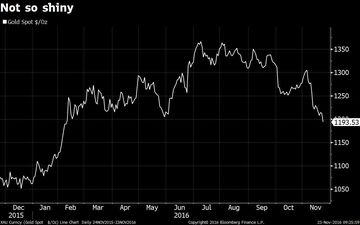

What's happened to gold?

Conventional wisdom held that the uncertainty that would follow a Donald Trump victory in the election would be very positive for safe-haven assets like gold, but since Nov. 8 the shiny stuff has fallen by more than 6 percent to below $1,200 per ounce.


Source: Bloomberg

And if gold's a hedge against rampant inflation, wouldn't the imminent installment of the inflation president also prove a boon?

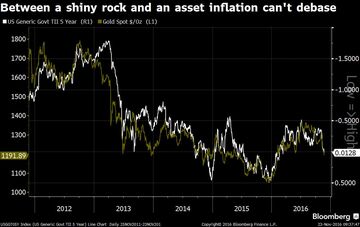
That may be because although fears of (in/de)flation, the disintegration of civilization in general or the European Union in particular, food prices, investor sentiment, and bets on monetary disorder have all taken their turns in being cited as the key factor in gold investment theses, the behavior of real rates has proved far more important in explaining bullion's gyrations.

Following durable goods orders for October that more than lived up to their name and dispelled any notion of election-related uncertainty restraining business activity ahead of the event, the yield on five-year Treasury Inflation-Protected Securities (or TIPS) broke into positive territory, hitting levels not seen since March 16, as gold tumbled.


Source: Bloomberg

Such an observation is hardly novel.

Eddy Elfenbein, portfolio manager at AdvisorShares Investments LLC and founder of Crossing Wall Street, has built a model predicting where gold prices will go based on the deviation of short-term real interest rates from their natural level. The Globe and Mail's Scott Barlow has also explained the relationship between the two assets on a number of occasions.

The thinking here is that the value of a hard asset with a yield of zero (net of storage costs) will be affected by the relative real yield on assets that are considered risk free, an alternative holding. In other words, the so-called opportunity cost of buying gold rises as real Treasury yields increase.

So if you want to know how the president-elect is changing the outlook for gold, looking at inflation-protected Treasury yields instead might prove more useful than searching for nascent signs of Trumpflation.


Monday, November 21, 2016

#RIPUSA Trump and his promise to move the US Embassy to Jerusalem


trump1d

 Moving the US embassy from Tel Aviv to Jerusalem would be a good example of the kind of policy change that President-Elect Donald Trump has said is needed in Washington. More importantly, this action could mark a new US strategy for pursuing Israeli-Palestinian peace: Telling the truth.
The US State Department, which has always opposed moving the US embassy in Israel from Tel Aviv to Jerusalem, understands very well that any peace agreement between Israel and the Palestinians will leave at least western Jerusalem as Israel’s capital and part of sovereign Israel. So why will the State Department nevertheless advise President-Elect Donald Trump not to fulfill his promise to move the embassy?
Moving the embassy to Israel’s actual capital would provoke Arab anger at the US and lead to protests that might turn violent. The foreign policy establishment wishes to prevent this result and protect America’s status as an “honest broker.” It therefore continues to insist that because Jerusalem’s ultimate status can only be determined by agreement between Israel and the Palestinians, and that it would be wrong for the US to “prejudge” the outcome by acting on the truth that Israel’s capital is Jerusalem.
This is a perfect example of the kind of politically-correct establishment pettifogging that Trump campaigned against. Moving the embassy to Jerusalem is a low-cost action that he could take as soon as he is inaugurated, and one of the easiest and quickest changes in policy that he could implement. The new US consulate in Jerusalem was built with security features that would be needed for an embassy, so the move could be started almost immediately, without any prejudice to the Palestinian claim to eastern Jerusalem.
The State Department’s insistence on the diplomatic fiction that none of Jerusalem is part of Israel helps preserve the Palestinian hope that, someday, Israel will be forced to give up its capital and will be destroyed as the independent, democratic Jewish state.
That Palestinian hope is the main obstacle to peace. The Palestinians can only make peace when their community – and perhaps the Arab world of which it is a part – comes to understand that international pressure will never force Israel to acquiesce in its own destruction. One of the best ways the US can demonstrate that it will never consent to the Palestinian destruction of Israel is for Washington to stop ignoring blatant Palestinian lies that work against peace.
There is another way that an American truth-telling strategy could encourage peace.  Palestinian leadership now tells its people – and most of them believe – that compromise with Israel would be immoral because Israel is a colonial invader that stole Palestinian land by force. By that argument, Israel has no moral claim to any of the land, and any concession to it would be dishonorable.
But Israel is descended from Jewish kingdoms that ruled parts of the land for centuries in ancient times. It too has a traditional base for moral claims to the territory (in addition to legal claims from the League of Nations mandate). If the Palestinians recognized this truth, they would see that compromise between the two groups, each of which has valid claims to the land, could be an honorable way to end the dispute and not a cowardly yielding to force.
To undermine this moral basis for compromise with Israel, Palestinian leadership flatly denies any ancient Jewish connection to the land. They claim, for example, that there never was a Jewish temple on the Temple Mount from which Jesus could have chased the money-changers. Yet their own history belies this claim. In 1929, the Supreme Moslem Council in Jerusalem, in its guide to the Mount, wrote: “[The Temple Mount’s] identity with the site of Solomon’s Temple is beyond dispute.”
The US may not be able to induce the Palestinian Authority to stop inciting its constituents and teaching its children to hate Israel. But there are ways in which the US can expose and eventually defeat Palestinian lies that work against peace; ways that do not require getting agreement from anyone.
Exploring these new approaches would constitute a striking change in diplomatic direction. There are many examples of the West rejecting truth on behalf of the Palestinians and their Arab supporters. For example, some Western countries went along with the recent denial by UNESCO of any ancient Jewish connection to the land of Israel. The US politely ignores the Palestinian lie that there was never a Jewish temple on the Temple Mount.
If the US consistently tells the truth about the ancient Jewish presence in Palestine, and publicly refuses to swallow the Palestinians’ false and anti-peace denials of history, the Palestinian leadership will not for long be able to keep the truth from their people, or at least from the large educated class.
The US has followed a policy of avoiding truths that are painful or embarrassing to the Arabs for at least 50 years. It hasn’t worked. Maybe it is time to try the strategy of telling the truth. Moving the US embassy to Jerusalem, in accordance with the long-standing congressional position, would be a good way for President Trump to make a start on a truth-telling strategy – as well as to fulfill a campaign promise.