Showing posts with label Iran Nuclear Deal. Show all posts

Wednesday, February 15, 2017

Two State Solution will no longer be forced upon Zion at least in the 8 years of #OyVeyDonaldTrump's Presidency and or until he is impeached . Unlikely as long as the GOP contriols both the Senate and The House.

Related image


Trump Administration Will Not Insist on Two-State Solution in Middle East, White House Official

Breaking with decades of U.S. foreign policy, the Trump administration will not insist on a two-state solution for the Israeli-Palestinian conflict when President Donald Trump hosts Israeli Prime Minister Benjamin Netanyahu on Wednesday.

Senior White House officials signaled the shift in a briefing to reporters late Tuesday in advance of the summit — the two leaders' first in-person meeting since Trump took office.

"Maybe, maybe not," one official said of the two-state solution. "It's something the two sides have to agree to. It's not for us to impose that vision. But I think we'll find out more about that tomorrow ."

The official emphasized that Trump seeks to bring peace to the turbulent region, even as he has promised a far closer relationship with Netanyahu and Israel under his presidency. Netanyahu and former President Barack Obama repeatedly clashed, and in one of his final acts in office, Obama declined to veto a UN Security Council resolution condemning Israel's expansion of settlements in West Bank areas claimed by Palestinians as part of a future state.

"A two-state solution that doesn't bring peace is not a goal that anybody wants to achieve," the official said. "Peace is the goal, whether it comes in the form of a two-state solution if that's what the parties want or something else, if that's what the parties want, we're going to help them."

The two-state solution has been a central aim of American foreign policy in the region for decades, and was embraced by both the Israeli government and the Palestinian Authority. But in recent years it has appeared to be an ever-fleeting dream, amid demographic changes, settlement expansion, security concerns, and eroding trust between the two parties.


The official said that the prospect of a future meeting between the Israeli government and Palestinian Authority leaders would be on the agenda for Trump's meeting with Netanyahu. "He's hopeful to bring the two sides together to discuss peace," the official said of Trump, adding the issue of Middle East peace is a "very high priority" for the new administration.

Trump and Netanyahu will host a joint press conference in the East Room of the White House Wednesday, before holding a bilateral meeting and a working lunch. The official said the administration hopes the visit will "usher in a new relationship between Israel and the United States — something that Israel has not seen in well over eight years, a relationship that will show there is no daylight, that we are fully cognizant of the situation that Israel finds itself in."

The official said that under the Trump administration, "The posture that the U.S. takes at the UN under this administration would be to veto anything that is biased against Israel."

The official added that the settlement issue will be also be on the agenda for the meeting. Earlier this month, White House Press Secretary Sean Spicer said in a statement that the White House did not believe the construction of new settlements or the expansion of existing settlements beyond their current borders would be "helpful" in achieving a lasting peace accord. The statement followed a day after the Israeli government approved an entirely new settlement construction in the West Bank.

Iran, its status as a state sponsor of terror, and its nuclear program, would be a crucial part of the discussion, the official said. Netanyahu was outspoken in his opposition to the Iran nuclear agreement under the Obama administration, though Trump has pledged to rigorously enforce the agreement, rather than abrogate it. Officials maintain that the agreement has rolled-back the "breakout" time for Iran to build a functioning nuclear weapon from a matter of months to a year.

Also on tap for the meeting will be a discussion of moving the U.S. Embassy in Israel from Tel Aviv to Jerusalem — long a goal for Netanyahu and many pro-Israel Americans. While Trump repeatedly pledged support for the move as a candidate and during the presidential transition — and even considered ordering it moved immediately after he took office on Jan. 20 — the White House put the brakes on the effort after Trump was briefed by his aides and amid pressure from Arab allies in the region.

"We are at the early stages of this decision-making process," Spicer told reporters on Jan 23. When pressed if he could commit that at the end of Trump's first term that the embassy would be moved, Spicer replied, "If it was already a decision, we wouldn't be going through a process."

Trump follows both Presidents Bill Clinton and George W. Bush in publicly expressing support for the embassy move during the campaign, before delaying it at the behest of national-security leaders and Middle East experts as detrimental to the peace process.

During his confirmation hearing in January, Secretary of Defense James Mattis told Senators he believes Tel Aviv is the capital of Israel and deferred to the Secretary of State on whether it should be moved. "The capital of Israel that I go to, sir, is Tel Aviv, sir, because that’s where all their government people are," he testified. The issue did not come up during the confirmation hearings for Trump's nominee to head the State Department, Rex Tillerson.

Trump faces a June 1 deadline to weigh in formally on the subject when the final six-month Obama waiver of the Jerusalem Embassy Act expires

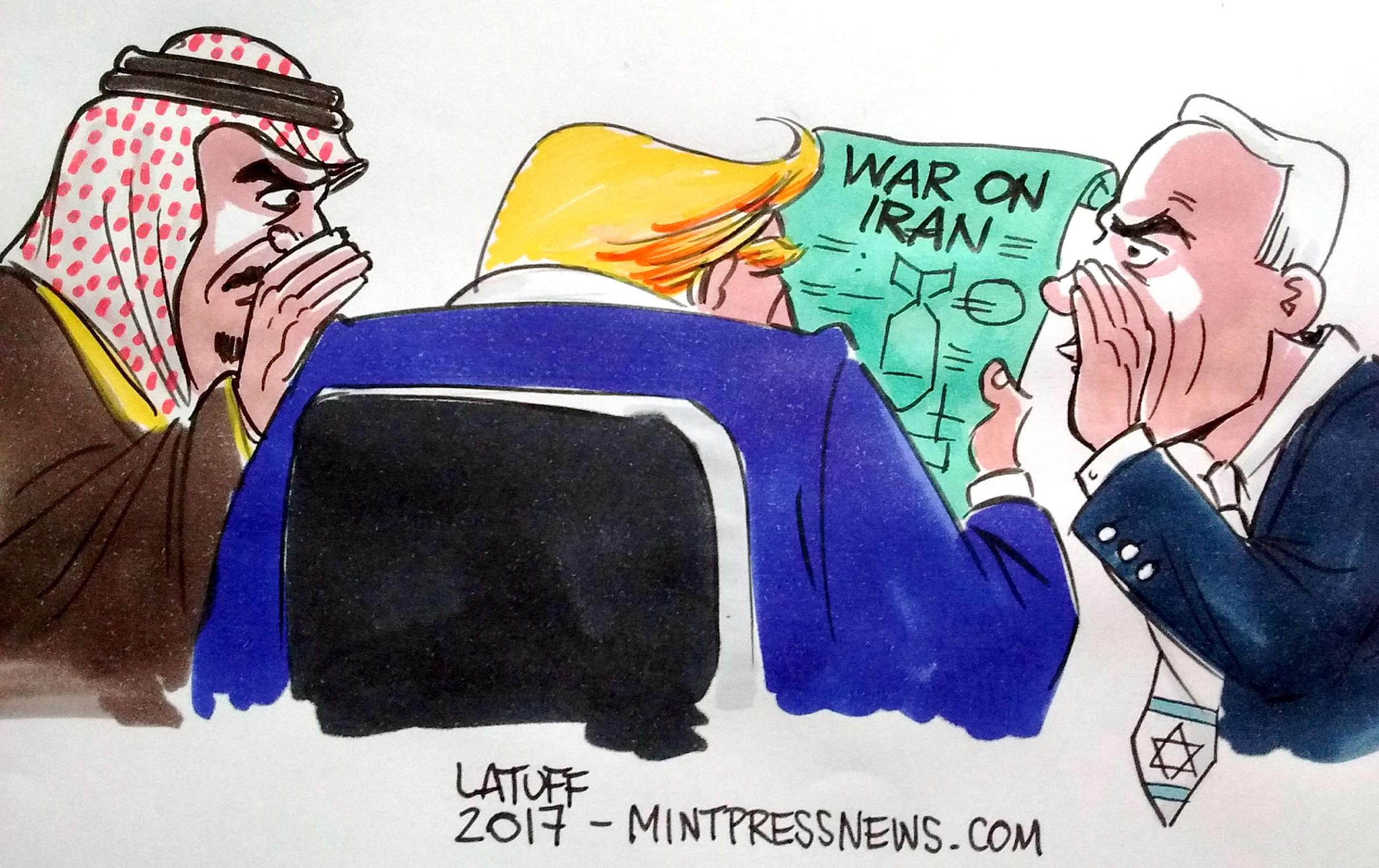
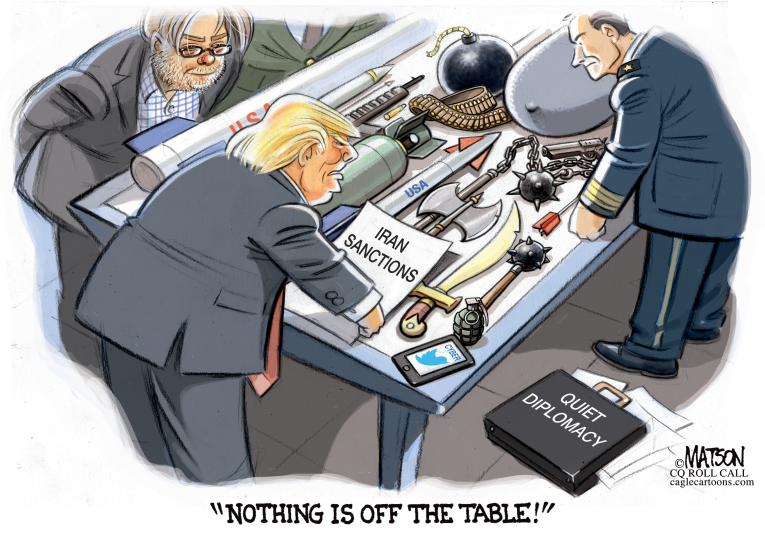
Iran Missiles Test and Nuclear deal .. #OyVeyDonaldTrump's agressive pugnacity is difficult to turn into action unless he back tracks from #RIPPaxAmerica ....that the USA is no longer the policeman of the world


Donald Trump’s bellicosity on Iran is tricky to turn into action

Image result for Trump ... Iran words no action cartoon
The assembly with Netanyahu will put the main target on the president’s Mideast coverage

Before the election: Donald Trump meets Benjamin Netanyahu, the Israeli prime minister, in New York

As Benjamin Netanyahu, Israel’s prime minister, arrives on the White House at present for his first assembly with Donald Trump since he grew to become US president, the connection between the 2 males is not as clear because it appeared even final week. On the marketing campaign path, Mr Trump vowed he could be the “most pro-Israel president ever”.

Upon taking workplace, nevertheless, he has maintained Twitter silence on his pledge to transfer the US embassy from Tel Aviv to Jerusalem and began equivocating concerning the tempo of Jewish settlement-building on Arab land, saying this “may not be helpful”.


“Every time you take land for settlements, there is less land left”, the property mogul helpfully noticed. Early this month, King Abdullah of Jordan is believed to have spelt out to Mr Trump that Israel’s new settlement binge, alongside a US showing to foreclose on the standing of Jerusalem — the place Jordan is enshrined by treaty because the guardian of Islamic holy websites — would additional destabilise the area and encourage extremists.

The far proper within the Israeli cupboard believes that Mr Trump’s election presents a possibility to annex a lot of the occupied West Bank and finish the worldwide narrative encouraging a Palestinian state. Mr Netanyahu’s place zigzags between specious reasoning and slippery irredentism. There are those that consider Mr Trump’s unwonted warning on Israel is a tactic to give Mr Netanyahu US cowl on his uncovered proper flank at home. Others suppose the president is seduced by the thought of the “ultimate deal” — not simply between Israel and the Palestinians however Arab allies akin to Saudi Arabia.

All this is up for dialogue. Much of it’s going to keep up . . . within the air. The meat of this assembly, in the meantime, can be Iran and its allies, akin to Hizbollah, the Lebanese Shia Islamist paramilitaries Israel has been combating for 35 years.

Insofar as something is clear about Mr Trump’s Middle East insurance policies it is that he’ll need to work with Israel and Russia to limit and possibly roll again Iran’s rising affect within the area. This intersects with Israel’s concern far more than it does with Vladimir Putin’s Russia, which alongside Iran’s Revolutionary Guards, Hizbollah and Iraqi Shia militias, has salvaged Bashar al-Assad’s regime in Syria.

It is laborious to overstate the antagonism of workforce Trump in the direction of Iran — even when it has simply misplaced Michael Flynn, the shortlived however fanatical national safety adviser,. Candidate Trump known as final yr’s nuclear curbs deal between Iran and the worldwide group — the jewel of former President Barack Obama’s international coverage — “one of the worst deals ever”, and vowed to eviscerate it.

His administration has simply added to sanctions on Iran for what it sees as provocative current exams of ballistic missiles. Yet, though President Trump began out as ultra-bellicose on Iran, he might finish being constrained by intractable info. He might properly come to realise that militarily there are limits to what he can do, at the least with out pouring gasoline on to a area on hearth. While clearly the US has levers, he might discover tightening the sanctions screws unexciting, since they won’t considerably loosen Iran’s regional grip. He might, in different phrases, hint an identical arc to Israel, which lengthy excited hypothesis that it would bomb Iran’s nuclear infrastructure.

And that would lead him to the place Israel is now: its focus firmly on Hizbollah.

During its final, 34-day battle with Israel in 2006, the Lebanese paramilitaries held it to a draw. But after 5 years combating in Syria, Hizbollah has develop into a formidable Arab military, blooded, assured and bristling with a extra lethal arsenal of missiles. Always current on Israel’s northern border with Lebanon, Israel is on alert to Hizbollah bringing Iran shut to its border with Syria, the place till this civil battle the Assad regime had ensured not a shot had been fired for 40 years.

In the previous 10 weeks, Israel has carried out at the least 5 missile or air strikes inside Syria towards alleged convoys and stockpiles of weapons meant for Hizbollah, together with of “game-changing” Russian-made surface-to-air missiles that might dispute Israel’s mastery of the skies. The subsequent battle with Hizbollah is mentioned as a given.

The Institute for National Security Studies, Israel’s high think-tank, final month described Hizbollah as “currently the gravest military threat to Israel”, forward of its sponsor Iran. While Tehran declares its personal and its allies’ defiance, the temptation for the Trump administration ultimately to approve of an Israeli marketing campaign towards Hizbollah is seemingly to develop. Part of Hizbollah’s operate as a proxy is that it serves as the subsequent neatest thing to attacking Iran straight.

Tuesday, February 14, 2017

#OyVeyDonaldTrumps Threefold Challange Against Iran

Image result for Donald Trump Iran Cartoon

The Trump administration has commenced with a tempest of policy implementation of promises made during the election campaign in areas of policy such as immigration, trade, health care, the Supreme Court, and many others. They mostly related to domestic policy and the American economy. Regarding the Middle East, the administration has adopted a different style of rhetoric from that of the previous administration. Nevertheless, there is no strong evidence for a new regional policy: whether in relation to Iran and the nuclear deal, the humanitarian catastrophe in Syria, or the issue of intensifying the war against ISIS and all forms of radical Islam. When shaping its Middle East policy in general and its policy on Iran in particular, the new administration will need to come to terms with major tensions within its policy targets—declared and undeclared—vis-à-vis Iran (regarding nuclear issues, regional influence, terror and subversion, long-range missile development, cyber warfare, and soft power) and other rivals (ISIS, Russia, China, North Korea). All of this must be dealt with under the guiding principle of “America first.”
This article expounds upon the proposed American policy vis-à-vis Iran, and the inputs that Israel can contribute to shaping this policy.

Where does Iran Challenge the United States?

US National Security Adviser Mike Flynn speaks during the daily press briefing at the White House in Washington, DC, on February 1, 2017. NICHOLAS KAMM / AFP
The first front on which Iran challenges the new American administration is that of the nuclear agreement. In response to Trump’s call during the campaign to reopen the July 2015 agreement between Iran and the P5+1, Iran declared that it is unwilling to do so. Recently, the Atomic Energy Organization of Iran even stated that it intends to input enriched material into advanced centrifuges (IR-8), in order to advance the research and development program of centrifuges that are more efficient than those currently used in Iran. The Iranian goals are to develop its technological ability to enrich uranium, to quickly amass fissile material, to reduce the size of installations required for future industrialized enrichment, and to make it easier to hide enrichment facilities should it choose to do so. This is not a blatant violation of the nuclear agreement, but rather “gray area” activity that depends on one’s interpretation of the agreement. Iran is attempting to force its interpretation, which naturally is more permissive than the American interpretation, and is testing American resolve to enforce the agreement in accordance with its own interpretation.
The second front pitting the Trump administration against Tehran appeared in the headlines this month thanks to a failed Iranian test of a North Korean-model ballistic missile, capable of carrying a nuclear warhead some 4000 kilometers. Although the United States and Germany declared that the test launch violated UN Security Council resolution 2231, this resolution does not unequivocally prohibit Iran from performing such a test, but “calls” for it not to carry out tests of ballistic missiles capable of carrying nuclear weaponry. Just as with the nuclear issue, Iran is not violating the resolution, but challenging it in practice and testing American willingness to respond. Furthermore, it has been reported that Iran tested a cruise missile capable of carrying a nuclear warhead. This action also does not violate the Security Council resolution, which does not relate to cruise missiles, but only ballistic missile tests.
The third front where Washington faces Tehran is in the non-nuclear realm. Iran works to expand its regional power against its main enemies—Israel and Saudi Arabia—by establishing militias and military proxies, as well as by providing Iranian weaponry and support to terror organizations. Against Israel, Tehran continues to support Hezbollah and supply it with advanced weapons, with the aim of enhancing its ability to threaten Israel. Iran also solidifies its power in Syria and Lebanon, including through ethnic cleansing of Sunni areas and settlement of Shiite populations in their stead, creating zones of Iranian influence. This is all undertaken while strengthening the alliance with Assad and Hezbollah.
Iran supports the Houthi rebel organizations fighting US allies in Yemen, Saudi Arabia, and the United Arab Emirates. Iran deals in subversion, destabilization, and terror among Shiite populations in the Gulf states, with a focus on northeastern Saudi Arabia and Bahrain. In the last few months, the conflict has even spread from land to sea: reports were published this week that Houthi forces attacked a Saudi ship in the Red Sea, killing two seamen. This follows the October 2016 attack by Houthi forces on a UAE ship, and the unsuccessful attempt to attack an American destroyer with Iranian surface-to-ship missiles. Generally, these attacks have been directed against US allies, not against American forces. On this front, too, Iran does not directly defy Washington, but aids the fight against its allies in an attempt to undermine the strength of the American-Sunni alliance in the Middle East.
From Iran’s perspective, this is merely a continuation of the cautious strategy of “testing boundaries” that was applied against the previous American administration. The Obama administration was determined to reach a deal with Iran regarding its nuclear program. For this purpose, it was willing to compromise on American interests and the interests of American allies while avoiding a significant escalation with Iran that could have endangered the administration’s diplomatic achievement in the nuclear issue. The assumption of the previous administration was that the alternative to an agreement was regional war, and that an agreement should be reached, even a non-optimal one, which should then be diligently implied.
Furthermore, it appears that Iran’s own self confidence has grown stronger due to Russian support and the increased cooperation between Tehran and Moscow since the signing of the Joint Comprehensive Plan of Action (JCPOA). Russia took advantage of the American passivity in Iraq and Syria in order to reassert its hold over the Middle East, finding a partner for this in Iran. Although this is not a strategic alliance, and there is mutual suspicion between Iran and Russia, both have made sure to successfully coordinate their actions in Syria, and to promote further common interests in preserving the Assad regime, expanding the supply of advanced Russian weaponry to Iran, and collaborating in the field of civil nuclear power.

American Resolve is required
In response to the ballistic missile test conducted by Iran, the Trump administration announced sanctions against Iranian organizations and persons connected with terror activities and the Iranian missile program. In addition, an American battleship was sent to the Bab el-Mandeb region to secure trade routes against Houthi rebels in Yemen, who are supported by Tehran. The objective of the American response, as stated by President Trump, was to refuse to show restraint in the face of problematic Iranian conduct and to deter the Iranian regime from continuing its wayward regional policy. Nevertheless, the statement by Defense Secretary James Mattis that he is not considering to increase American forces in the region shows that the new administration has yet to fully formulate a strategy that will significantly change the strategic reality vis-à-vis Iran as shaped by the Obama administration. Thus, the challenge facing the new American administration is, on the one hand, to block Iran on all the fronts where it is challenging the United States, while on the other hand to avoid escalation at an undesirable time.
The change in American rhetoric—as expressed in the statement of General Michael Flynn that Iran is “on notice,” and as reinforced by President Trump’s statement that Iran is “playing with fire”—was necessary to make clear to Iran that the rules of the game have changed. But words must be backed up by equivalent deeds that display the same level of force. The Trump administration should restore the credibility of American policies and declarations in order to deter Iran from taking negative policy steps, while strengthening Middle East stability and protecting the interests of the United States and its allies in the region.
In order to formulate a different policy on Iran, the Trump administration must confirm the following basic assumptions: a) rejection of the Obama administration’s assumption that there is no alternative to an agreement; this assumption paralyzed the previous administration. The new administration should start with an assumption that the alternative to an agreement is not necessarily war; b) the alternative to the existing agreement, should Iran pull out of it, is the restoration of significant sanctions and a credible military option. If Iran should move to nuclear breakout, the response should be a surgical military strike only against nuclear facilities and containment of the incident. Against a strong and determined administration, the possibility of escalation should scare Iran rather than the United States.
Based upon these decisions, it would be appropriate to define a strategy for two main time frames: the short-medium term, and the long term. In the short and medium terms, the Trump administration should work with other world powers to form a consensus regarding which actions by Iran would be considered a violation of the nuclear agreement. Even without Russian or Chinese agreement, the United States and its European allies should agree on interpretation and coordinate a response for the “gray area” violations. It should be clear that the United States, United Kingdom, France and Germany are committed to the agreement solely in accordance with a strict interpretation.
In parallel, Washington should push for a new Security Council resolution to replace Resolution 2231, which would unequivocally prohibit the test of Iranian ballistic and cruise missiles that can carry a nuclear warhead. Such actions would demonstrate—to both Iran and other world powers—American resolve to create new rules of the game.
Russia is a key country for implementation of this strategy. President Trump has stated that he intends to act in coordination with Russian president Vladimir Putin. In a future agreement between these leaders, it is essential to include a demand to weaken Iran’s hold in Syria, with a focus on Iranian deployment in southern Syria and the Golan Heights. Another important issue is the cessation of the supply of advanced Russian weaponry to Assad, and from him to Hezbollah rendering a direct threat against Israel.
Furthermore, the American administration should increase pressure on Iran’s alliances and relationships with terror organizations in the region, using counterterrorism and deterrence. This policy should include a joint intelligence effort of the United States and its regional allies, as well as Israel, along with the employment of targeted force aimed at stopping Iranian weapon deliveries by sea and air. Also in this arena, an aggressive policy against Iran’s system of alliances, and injury to the Quds Force, is necessary so that Tehran will understand that the Trump administration intends to deal with Iran and take risks not taken in the past by the United States.
The Trump administration seeks to make clear that it is not willing to permit provocative Iranian actions, but it is important to avoid uncontrolled escalation during the years when Iran is far from the nuclear threshold. The suggested strategy demonstrates that there is an alternative to an agreement, which will further regional stability while not lead to a regional war. For this purpose, it is important to avoid tactical and local responses, and to formulate a comprehensive strategy intended to weaken Iran.
Regarding the long-term, the American strategy should include preparatory plans with the aim of preserving the credibility of the American threat, even after some of the main restrictions on the Iranian nuclear program are removed, beginning at the end of the seventh year of the agreement. A major component of the strategy must be amending the agreement, which currently allows in the long term for Iran to become the legitimate, unrestricted owner of nuclear infrastructure. For this purpose, the US administration must create, together with its allies, deterrent and punishment mechanisms that will deter Iran from developing its nuclear program and approaching the nuclear threshold, and being a mere few months or weeks from a bomb. The enforcement mechanisms should also include the possibility—coordinated with the world powers that signed the agreement—of restoring a significant sanctions regime, which in the past led Iran to the negotiating table and to compromise.
The US administration should be ready for Iran to decide to withdraw from the agreement, or in the future to exploit the removal of restrictions as prescribed by the agreement and advance to nuclear weapons. Then, the ability to harm the Iranian economy’s financial and energy sectors and a credible threat of focused military force as a last resort to prevent a nuclear Iran will be a key to deter Iran. These deterrent mechanisms might be the only tools capable of preventing a nuclear Iran while also avoiding a large-scale regional military conflict.

The Israeli Input
For Israel, too, words must lead to deeds. Prime Minister Binyamin Netanyahu has declared that he intends to make the Iranian issue the main priority in the talks he will be holding with President Trump. Iran and its proxies, especially Hezbollah, are the greatest strategic threat currently facing Israel. Since summer 2015 we have been recommending an American-Israeli “parallel agreement” for coping with the consequences of the JCPOA and Iran’s malignant activities. Today there is an additional Israeli interest in establishing a strong regional front under American leadership against the extensive Iranian activities in the region. Formation of such a front would be a crucial and meaningful achievement for the stability of the Middle East and containment of Iran.
The formation of this type of regional anti-Iranian alliance may obligate Israel to make significant adjustments in the Palestinian issue. If President Trump would be willing to pursue bilateral agreements with his allies and perhaps even work towards convening a regional coalition with the participation of the United States, the Sunni Gulf states, and Israel, it is imperative that the Israeli government initiate moves that would not foil these efforts. This would be the optimal way to advance the most important Israeli interests in the long term against Iran while advancing an Israeli-Palestinian settlement. 

Monday, January 9, 2017

Trump versus the Iranian nuclear deal


Cooling towers of a nuclear power plant

Donald Trump’s foreign policy platform may have been incoherent on most issues during the election campaign, but he was clear on the nuclear deal with Iran, known as the Joint Comprehensive Plan of Action (JCPOA). According to him it was “disastrous”, “lopsided” and a “disgrace”. What he intends to do about it is not so clear. He promised to tear it up in a speech for AIPAC. However, Walid Phares, one of his foreign policy advisors, suggested he would merely try to renegotiate the terms. Alternatively, he could simply leave the deal in place, and then play hard-ball with Iran as it is implemented. Trump is already backing-off on some of his more controversial promises, so this may all be campaign fodder. However, if he does try to meddle with JCPOA, no good will come of it.

Trump’s ability to either renegotiate or annul the deal will depend on his ability to reapply sanctions and/or use military force. Political conditions are not favourable for either. One of the main motivations for negotiating the deal in the first place was the fear that counter-proliferation strikes against Iran would be destabilising in the region and could possibly escalate out of control. The situation in the Middle East is now even more fragile and unpredictable than before. The campaigns in Mosul and Raqqa are progressing, but the Syrian civil war is far from over and Daesh will likely persist as a terrorist organisation even without a territorial base. Even when the fighting is over, Iran has a vital role to play in Syria’s post-conflict political reconstruction, as it did when the Karzai government was established in Afghanistan. Washington will need to maintain a working relationship with Tehran if it has any hope of getting this situation under control. Counter-proliferation strikes would make it impossible.

Reapplying sanctions would be no less problematic. While the JCPOA was being negotiated, its critics claimed that it would be impossible to snap-back sanctions if the deal broke down after it was signed. They were wrong then, but right now. The pre-deal sanctions on Iran were powerful because of the degree to which they were multilateral. China, Russia, the EU and Japan joined the US in isolating the Islamic Republic. Economically, there was almost nowhere for Tehran to turn. If Iran had broken its promises concerning the JCPOA, then Washington would have had the moral high ground, and would have been in a fairly good position to reconstitute that coalition and put the pressure back on Iran. However, if the deal is broken unilaterally by Donald Trump, the US will look like the villain. He would have a hard time convincing allies that he dismissed as free-riders to give up lucrative new contracts with Tehran and fall back in line.

If Trump cannot convincingly threaten Iran with military force or multi-lateral sanctions, there would be little to constrain Iran’s nuclear programme if the JCPOA was torn up. Indeed, given Trump’s rhetoric, if Trump annulled the agreement, Tehran would have extra motivation to weaponise. Even if he just wanted to renegotiate, he would have very little leverage. Most worrying, he could miscalculate. If he reopened the deal and Iran did not make concessions, Trump could resort to bluster and bullying and talk himself into a situation where he had to use military force or admit defeat.

It is impossible to predict what a Trump administration would do, but the points above suggest the hard-ball option is the most likely choice. In addition to ramping up the rhetoric, Washington could look for ways outside the JCPOA framework to increase pressure. It could impose sanctions punishing Iran for its ballistic programme or its involvement in Yemen. Similarly, it could insist on the JCPOA being interpreted and implemented in strict and narrow terms. In April, for instance, Washington offered to purchase the excess heavy water Iran produced to allow Tehran to meet its obligations under the JCPOA. Instead, the Trump administration could turn any such event into an excuse to delay implementing its own obligations, such as allowing Iran access to western banks.


Ironically, limited hard-ball tactics may play well in Tehran. Iran’s Supreme Leader Ayatollah Ali Khamenei always seemed in two minds on the JCPOA. On one hand, the agreement was necessary for Iran in order to end its diplomatic and economic isolation. On the other, improving relations with the US contradicted the narrative of the revolution and threatened the regime’s identity. So far, Khamenei has tried to have it both ways. He supported the negotiating team during the talks but all the while maintained a steady barrage of anti-American rhetoric. Trump’s posturing may therefore make it easier for him to preserve the “Iran versus the Great Satan” motif in the regime’s official discourse. However, if Trump goes beyond talking tough, he could undermine the deal all together. Iran’s moderate President, Hassan Rouhani, is already under pressure from conservative opponents who, like their American counterparts, believed the JCPOA was a capitulation. He does not have the political capital to make further concessions. Moreover, if the hard-ball tactics actually began to hurt Iran’s economic recovery, Khamenei may conclude that the benefits of the JCPOA no longer outweigh the costs. If so, Trump will not have to tear up the agreement, Khamenei will do it for him.