Showing posts with label #RIPPaxAmericana. Show all posts

Thursday, March 9, 2017

#OyVeyDonaldTrump Promises on Zion, Israel and Antisemitism ..... nothing but hot air and extreme disapointment so far.

Image result for Cartoon Trump promises on israel and anti semitism hot air balloon
Trump disappoints on US antisemitism and Israel

President Trump's reaction to growing US antisemitism has been tepid, while on Israel the administration is beginning to sound like previous governments in Washington.

Prime Minister Benjamin Netanyahu has just returned from a highly successful trip to Singapore and Australia and is on his way to Moscow to consult with Russian president Vladimir Putin about mutual interests. Under his guidance Israel has strengthened relations with Asia/Pacific, Africa and Latin America and is outflanking the Israel-phobic countries of continental Europe by also improving relations with the UK. Sub-rosa collaboration with Egypt, Saudi Arabia and the Gulf states continues to burgeon.

So far so very good. Economic activity is booming and Israel's financial situation has never been stronger. Export of natural gas is set to begin and that bonanza is likely to continue to grow for the foreseeable future, now that exploitation of the Leviathan field has been announced. The strength of the shekel in the face of central bank sales may be creating problems for Israeli exporters but it is a faithful indication of the market's view of Israeli prospects

But a dark cloud is beginning to form on Israel's western flank. For a long time it looked as if the US, still the most important foreign relationship Israel has, would avoid the new wave of antisemitism afflicting Europe. But no longer. Anti-semitic activity has begun and has grown rapidly, with the spread of the BDS movement in universities and professional associations, threats to Jewish centers in many cities and desecration of Jewish cemeteries.

The reaction of the Trump administration, which was supposed to initiate a new era of Israeli-US relations, has been remarkably tepid, with the exception of Vice President Mike Pence. Even more disappointing has been the feeble response of most of the American Jewish organizations, with a few exceptions, such as the ADL. Thus a dilemma is being created for the government in Jerusalem (which according to the new secretary of defense is not located in the capital of Israel, which is Tel Aviv). Initial euphoria about the Trump administration is beginning to appear greatly exaggerated.

The American embassy is obviously not about to be moved to Jerusalem and warnings about building in the West Bank are becoming harsher and beginning to sound like previous governments in Washington.

Support for Israel in Congress has not weakened, at least so far, but that is the end of the good news. Action needs to be taken, quickly and strongly, by the Israeli government to encourage and collaborate with pro-Israeli forces in the US, including evangelical Christian groups, to ensure that antisemitic activities are denounced in the strongest terms and counter-actions undertaken. Support in state and municipal governments needs to be mobilized. Finally, the large group of American Jews who are indifferent to Israel need to understand that their love-affair with the "progressive" elements of the American left is encouraging and validating all kinds of dangerous activities which will boomerang against them sooner rather than later.

There is no room for complacency. The time for decisive action is now, before the ripples of antisemitism in the US become a tidal wave.

Wednesday, February 15, 2017

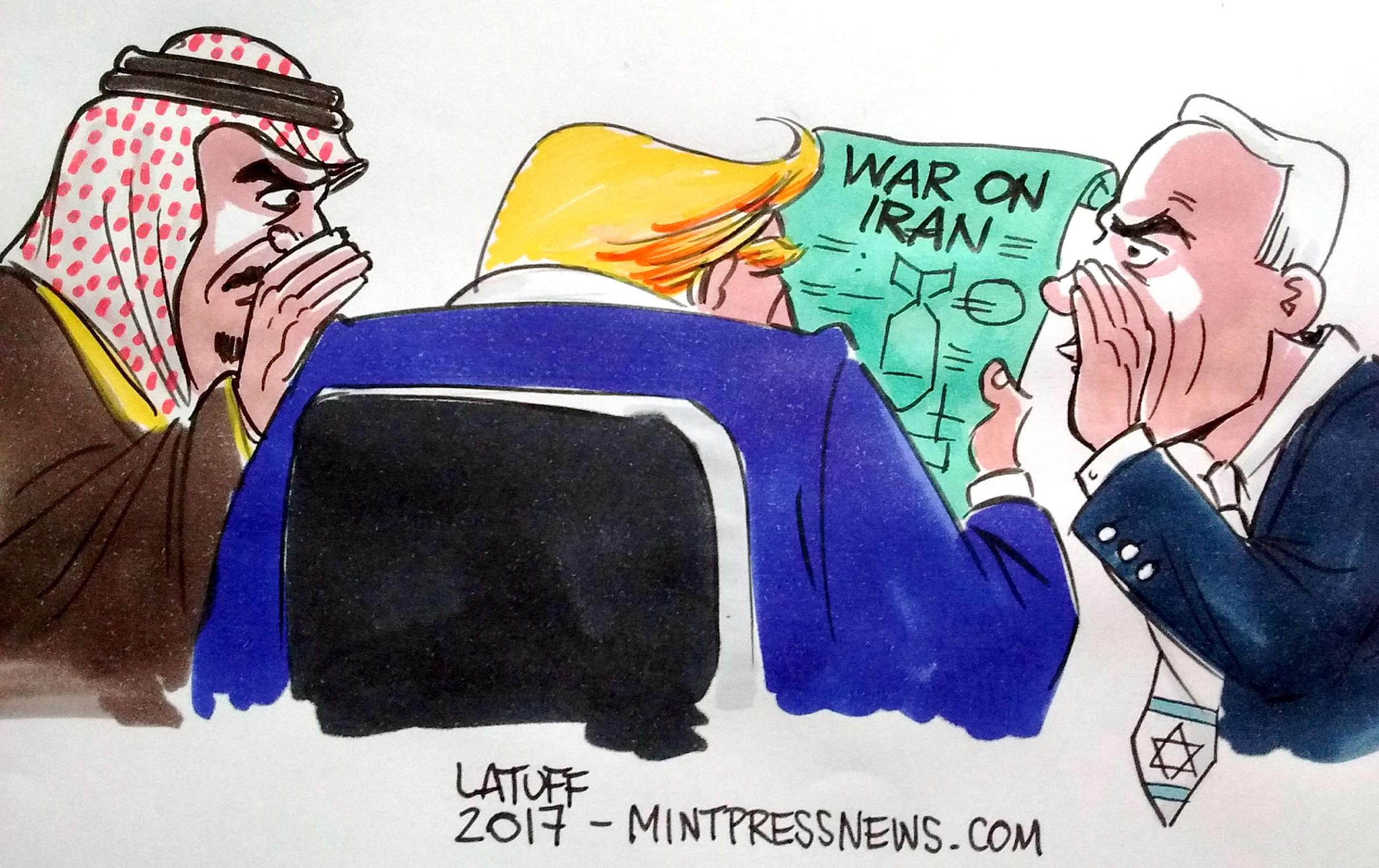
Iran Missiles Test and Nuclear deal .. #OyVeyDonaldTrump's agressive pugnacity is difficult to turn into action unless he back tracks from #RIPPaxAmerica ....that the USA is no longer the policeman of the world


Donald Trump’s bellicosity on Iran is tricky to turn into action

Image result for Trump ... Iran words no action cartoon
The assembly with Netanyahu will put the main target on the president’s Mideast coverage

Before the election: Donald Trump meets Benjamin Netanyahu, the Israeli prime minister, in New York

As Benjamin Netanyahu, Israel’s prime minister, arrives on the White House at present for his first assembly with Donald Trump since he grew to become US president, the connection between the 2 males is not as clear because it appeared even final week. On the marketing campaign path, Mr Trump vowed he could be the “most pro-Israel president ever”.

Upon taking workplace, nevertheless, he has maintained Twitter silence on his pledge to transfer the US embassy from Tel Aviv to Jerusalem and began equivocating concerning the tempo of Jewish settlement-building on Arab land, saying this “may not be helpful”.


“Every time you take land for settlements, there is less land left”, the property mogul helpfully noticed. Early this month, King Abdullah of Jordan is believed to have spelt out to Mr Trump that Israel’s new settlement binge, alongside a US showing to foreclose on the standing of Jerusalem — the place Jordan is enshrined by treaty because the guardian of Islamic holy websites — would additional destabilise the area and encourage extremists.

The far proper within the Israeli cupboard believes that Mr Trump’s election presents a possibility to annex a lot of the occupied West Bank and finish the worldwide narrative encouraging a Palestinian state. Mr Netanyahu’s place zigzags between specious reasoning and slippery irredentism. There are those that consider Mr Trump’s unwonted warning on Israel is a tactic to give Mr Netanyahu US cowl on his uncovered proper flank at home. Others suppose the president is seduced by the thought of the “ultimate deal” — not simply between Israel and the Palestinians however Arab allies akin to Saudi Arabia.

All this is up for dialogue. Much of it’s going to keep up . . . within the air. The meat of this assembly, in the meantime, can be Iran and its allies, akin to Hizbollah, the Lebanese Shia Islamist paramilitaries Israel has been combating for 35 years.

Insofar as something is clear about Mr Trump’s Middle East insurance policies it is that he’ll need to work with Israel and Russia to limit and possibly roll again Iran’s rising affect within the area. This intersects with Israel’s concern far more than it does with Vladimir Putin’s Russia, which alongside Iran’s Revolutionary Guards, Hizbollah and Iraqi Shia militias, has salvaged Bashar al-Assad’s regime in Syria.

It is laborious to overstate the antagonism of workforce Trump in the direction of Iran — even when it has simply misplaced Michael Flynn, the shortlived however fanatical national safety adviser,. Candidate Trump known as final yr’s nuclear curbs deal between Iran and the worldwide group — the jewel of former President Barack Obama’s international coverage — “one of the worst deals ever”, and vowed to eviscerate it.

His administration has simply added to sanctions on Iran for what it sees as provocative current exams of ballistic missiles. Yet, though President Trump began out as ultra-bellicose on Iran, he might finish being constrained by intractable info. He might properly come to realise that militarily there are limits to what he can do, at the least with out pouring gasoline on to a area on hearth. While clearly the US has levers, he might discover tightening the sanctions screws unexciting, since they won’t considerably loosen Iran’s regional grip. He might, in different phrases, hint an identical arc to Israel, which lengthy excited hypothesis that it would bomb Iran’s nuclear infrastructure.

And that would lead him to the place Israel is now: its focus firmly on Hizbollah.

During its final, 34-day battle with Israel in 2006, the Lebanese paramilitaries held it to a draw. But after 5 years combating in Syria, Hizbollah has develop into a formidable Arab military, blooded, assured and bristling with a extra lethal arsenal of missiles. Always current on Israel’s northern border with Lebanon, Israel is on alert to Hizbollah bringing Iran shut to its border with Syria, the place till this civil battle the Assad regime had ensured not a shot had been fired for 40 years.

In the previous 10 weeks, Israel has carried out at the least 5 missile or air strikes inside Syria towards alleged convoys and stockpiles of weapons meant for Hizbollah, together with of “game-changing” Russian-made surface-to-air missiles that might dispute Israel’s mastery of the skies. The subsequent battle with Hizbollah is mentioned as a given.

The Institute for National Security Studies, Israel’s high think-tank, final month described Hizbollah as “currently the gravest military threat to Israel”, forward of its sponsor Iran. While Tehran declares its personal and its allies’ defiance, the temptation for the Trump administration ultimately to approve of an Israeli marketing campaign towards Hizbollah is seemingly to develop. Part of Hizbollah’s operate as a proxy is that it serves as the subsequent neatest thing to attacking Iran straight.

Tuesday, February 14, 2017

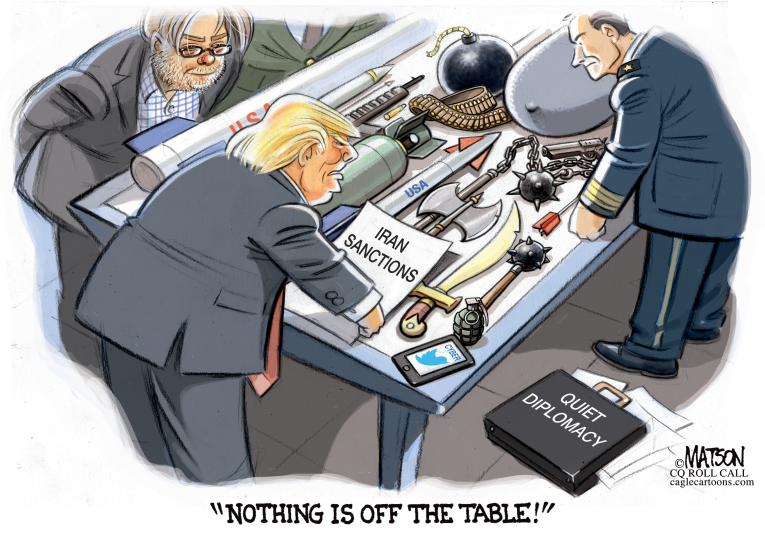
#OyVeyDonaldTrumps Threefold Challange Against Iran

Image result for Donald Trump Iran Cartoon

The Trump administration has commenced with a tempest of policy implementation of promises made during the election campaign in areas of policy such as immigration, trade, health care, the Supreme Court, and many others. They mostly related to domestic policy and the American economy. Regarding the Middle East, the administration has adopted a different style of rhetoric from that of the previous administration. Nevertheless, there is no strong evidence for a new regional policy: whether in relation to Iran and the nuclear deal, the humanitarian catastrophe in Syria, or the issue of intensifying the war against ISIS and all forms of radical Islam. When shaping its Middle East policy in general and its policy on Iran in particular, the new administration will need to come to terms with major tensions within its policy targets—declared and undeclared—vis-à-vis Iran (regarding nuclear issues, regional influence, terror and subversion, long-range missile development, cyber warfare, and soft power) and other rivals (ISIS, Russia, China, North Korea). All of this must be dealt with under the guiding principle of “America first.”
This article expounds upon the proposed American policy vis-à-vis Iran, and the inputs that Israel can contribute to shaping this policy.

Where does Iran Challenge the United States?

US National Security Adviser Mike Flynn speaks during the daily press briefing at the White House in Washington, DC, on February 1, 2017. NICHOLAS KAMM / AFP
The first front on which Iran challenges the new American administration is that of the nuclear agreement. In response to Trump’s call during the campaign to reopen the July 2015 agreement between Iran and the P5+1, Iran declared that it is unwilling to do so. Recently, the Atomic Energy Organization of Iran even stated that it intends to input enriched material into advanced centrifuges (IR-8), in order to advance the research and development program of centrifuges that are more efficient than those currently used in Iran. The Iranian goals are to develop its technological ability to enrich uranium, to quickly amass fissile material, to reduce the size of installations required for future industrialized enrichment, and to make it easier to hide enrichment facilities should it choose to do so. This is not a blatant violation of the nuclear agreement, but rather “gray area” activity that depends on one’s interpretation of the agreement. Iran is attempting to force its interpretation, which naturally is more permissive than the American interpretation, and is testing American resolve to enforce the agreement in accordance with its own interpretation.
The second front pitting the Trump administration against Tehran appeared in the headlines this month thanks to a failed Iranian test of a North Korean-model ballistic missile, capable of carrying a nuclear warhead some 4000 kilometers. Although the United States and Germany declared that the test launch violated UN Security Council resolution 2231, this resolution does not unequivocally prohibit Iran from performing such a test, but “calls” for it not to carry out tests of ballistic missiles capable of carrying nuclear weaponry. Just as with the nuclear issue, Iran is not violating the resolution, but challenging it in practice and testing American willingness to respond. Furthermore, it has been reported that Iran tested a cruise missile capable of carrying a nuclear warhead. This action also does not violate the Security Council resolution, which does not relate to cruise missiles, but only ballistic missile tests.
The third front where Washington faces Tehran is in the non-nuclear realm. Iran works to expand its regional power against its main enemies—Israel and Saudi Arabia—by establishing militias and military proxies, as well as by providing Iranian weaponry and support to terror organizations. Against Israel, Tehran continues to support Hezbollah and supply it with advanced weapons, with the aim of enhancing its ability to threaten Israel. Iran also solidifies its power in Syria and Lebanon, including through ethnic cleansing of Sunni areas and settlement of Shiite populations in their stead, creating zones of Iranian influence. This is all undertaken while strengthening the alliance with Assad and Hezbollah.
Iran supports the Houthi rebel organizations fighting US allies in Yemen, Saudi Arabia, and the United Arab Emirates. Iran deals in subversion, destabilization, and terror among Shiite populations in the Gulf states, with a focus on northeastern Saudi Arabia and Bahrain. In the last few months, the conflict has even spread from land to sea: reports were published this week that Houthi forces attacked a Saudi ship in the Red Sea, killing two seamen. This follows the October 2016 attack by Houthi forces on a UAE ship, and the unsuccessful attempt to attack an American destroyer with Iranian surface-to-ship missiles. Generally, these attacks have been directed against US allies, not against American forces. On this front, too, Iran does not directly defy Washington, but aids the fight against its allies in an attempt to undermine the strength of the American-Sunni alliance in the Middle East.
From Iran’s perspective, this is merely a continuation of the cautious strategy of “testing boundaries” that was applied against the previous American administration. The Obama administration was determined to reach a deal with Iran regarding its nuclear program. For this purpose, it was willing to compromise on American interests and the interests of American allies while avoiding a significant escalation with Iran that could have endangered the administration’s diplomatic achievement in the nuclear issue. The assumption of the previous administration was that the alternative to an agreement was regional war, and that an agreement should be reached, even a non-optimal one, which should then be diligently implied.
Furthermore, it appears that Iran’s own self confidence has grown stronger due to Russian support and the increased cooperation between Tehran and Moscow since the signing of the Joint Comprehensive Plan of Action (JCPOA). Russia took advantage of the American passivity in Iraq and Syria in order to reassert its hold over the Middle East, finding a partner for this in Iran. Although this is not a strategic alliance, and there is mutual suspicion between Iran and Russia, both have made sure to successfully coordinate their actions in Syria, and to promote further common interests in preserving the Assad regime, expanding the supply of advanced Russian weaponry to Iran, and collaborating in the field of civil nuclear power.

American Resolve is required
In response to the ballistic missile test conducted by Iran, the Trump administration announced sanctions against Iranian organizations and persons connected with terror activities and the Iranian missile program. In addition, an American battleship was sent to the Bab el-Mandeb region to secure trade routes against Houthi rebels in Yemen, who are supported by Tehran. The objective of the American response, as stated by President Trump, was to refuse to show restraint in the face of problematic Iranian conduct and to deter the Iranian regime from continuing its wayward regional policy. Nevertheless, the statement by Defense Secretary James Mattis that he is not considering to increase American forces in the region shows that the new administration has yet to fully formulate a strategy that will significantly change the strategic reality vis-à-vis Iran as shaped by the Obama administration. Thus, the challenge facing the new American administration is, on the one hand, to block Iran on all the fronts where it is challenging the United States, while on the other hand to avoid escalation at an undesirable time.
The change in American rhetoric—as expressed in the statement of General Michael Flynn that Iran is “on notice,” and as reinforced by President Trump’s statement that Iran is “playing with fire”—was necessary to make clear to Iran that the rules of the game have changed. But words must be backed up by equivalent deeds that display the same level of force. The Trump administration should restore the credibility of American policies and declarations in order to deter Iran from taking negative policy steps, while strengthening Middle East stability and protecting the interests of the United States and its allies in the region.
In order to formulate a different policy on Iran, the Trump administration must confirm the following basic assumptions: a) rejection of the Obama administration’s assumption that there is no alternative to an agreement; this assumption paralyzed the previous administration. The new administration should start with an assumption that the alternative to an agreement is not necessarily war; b) the alternative to the existing agreement, should Iran pull out of it, is the restoration of significant sanctions and a credible military option. If Iran should move to nuclear breakout, the response should be a surgical military strike only against nuclear facilities and containment of the incident. Against a strong and determined administration, the possibility of escalation should scare Iran rather than the United States.
Based upon these decisions, it would be appropriate to define a strategy for two main time frames: the short-medium term, and the long term. In the short and medium terms, the Trump administration should work with other world powers to form a consensus regarding which actions by Iran would be considered a violation of the nuclear agreement. Even without Russian or Chinese agreement, the United States and its European allies should agree on interpretation and coordinate a response for the “gray area” violations. It should be clear that the United States, United Kingdom, France and Germany are committed to the agreement solely in accordance with a strict interpretation.
In parallel, Washington should push for a new Security Council resolution to replace Resolution 2231, which would unequivocally prohibit the test of Iranian ballistic and cruise missiles that can carry a nuclear warhead. Such actions would demonstrate—to both Iran and other world powers—American resolve to create new rules of the game.
Russia is a key country for implementation of this strategy. President Trump has stated that he intends to act in coordination with Russian president Vladimir Putin. In a future agreement between these leaders, it is essential to include a demand to weaken Iran’s hold in Syria, with a focus on Iranian deployment in southern Syria and the Golan Heights. Another important issue is the cessation of the supply of advanced Russian weaponry to Assad, and from him to Hezbollah rendering a direct threat against Israel.
Furthermore, the American administration should increase pressure on Iran’s alliances and relationships with terror organizations in the region, using counterterrorism and deterrence. This policy should include a joint intelligence effort of the United States and its regional allies, as well as Israel, along with the employment of targeted force aimed at stopping Iranian weapon deliveries by sea and air. Also in this arena, an aggressive policy against Iran’s system of alliances, and injury to the Quds Force, is necessary so that Tehran will understand that the Trump administration intends to deal with Iran and take risks not taken in the past by the United States.
The Trump administration seeks to make clear that it is not willing to permit provocative Iranian actions, but it is important to avoid uncontrolled escalation during the years when Iran is far from the nuclear threshold. The suggested strategy demonstrates that there is an alternative to an agreement, which will further regional stability while not lead to a regional war. For this purpose, it is important to avoid tactical and local responses, and to formulate a comprehensive strategy intended to weaken Iran.
Regarding the long-term, the American strategy should include preparatory plans with the aim of preserving the credibility of the American threat, even after some of the main restrictions on the Iranian nuclear program are removed, beginning at the end of the seventh year of the agreement. A major component of the strategy must be amending the agreement, which currently allows in the long term for Iran to become the legitimate, unrestricted owner of nuclear infrastructure. For this purpose, the US administration must create, together with its allies, deterrent and punishment mechanisms that will deter Iran from developing its nuclear program and approaching the nuclear threshold, and being a mere few months or weeks from a bomb. The enforcement mechanisms should also include the possibility—coordinated with the world powers that signed the agreement—of restoring a significant sanctions regime, which in the past led Iran to the negotiating table and to compromise.
The US administration should be ready for Iran to decide to withdraw from the agreement, or in the future to exploit the removal of restrictions as prescribed by the agreement and advance to nuclear weapons. Then, the ability to harm the Iranian economy’s financial and energy sectors and a credible threat of focused military force as a last resort to prevent a nuclear Iran will be a key to deter Iran. These deterrent mechanisms might be the only tools capable of preventing a nuclear Iran while also avoiding a large-scale regional military conflict.

The Israeli Input
For Israel, too, words must lead to deeds. Prime Minister Binyamin Netanyahu has declared that he intends to make the Iranian issue the main priority in the talks he will be holding with President Trump. Iran and its proxies, especially Hezbollah, are the greatest strategic threat currently facing Israel. Since summer 2015 we have been recommending an American-Israeli “parallel agreement” for coping with the consequences of the JCPOA and Iran’s malignant activities. Today there is an additional Israeli interest in establishing a strong regional front under American leadership against the extensive Iranian activities in the region. Formation of such a front would be a crucial and meaningful achievement for the stability of the Middle East and containment of Iran.
The formation of this type of regional anti-Iranian alliance may obligate Israel to make significant adjustments in the Palestinian issue. If President Trump would be willing to pursue bilateral agreements with his allies and perhaps even work towards convening a regional coalition with the participation of the United States, the Sunni Gulf states, and Israel, it is imperative that the Israeli government initiate moves that would not foil these efforts. This would be the optimal way to advance the most important Israeli interests in the long term against Iran while advancing an Israeli-Palestinian settlement. 

Saturday, February 11, 2017

Largest Beneficiary of US Military Aid. Dispelling the Myth that that is Israel

Image result for Cartoon Pax Americana
Annual  US military aid:
Aid in form of funding: Israel:US$3.1 billion
Aid in form of cost of stationing US troops (does not include air and sea
patrols or joint ground, air, and maritime exercises with host countries)
Japan: US$27 billion
Germany: US$21 billion
South Korea: US$15 billion
Italy: US$6 billion

Many American detractors of Israel begin by citing that Israel receives
the lion’s share of US military aid. The very suggestion conjures the demon
of an all-powerful Israel lobby that has turned the US Congress into its
pawn. But these figures, while reflecting official direct
US military aid, are almost meaningless in comparison to the real costs and
benefits of US military aid – above all, American boots on the ground. In
reality, Israel receives only a small fraction of American military aid, and
most of that was spent in the US to the benefit of the American economy.

Countless articles discrediting Israel (as well as many other
better-intentioned articles) ask how it is that a country as small as Israel
receives the bulk of US military aid. Israel receives 55%, or $US3.1 billion
per year, followed by Egypt, which receives 23%. This largesse comes at the
expense, so it is claimed, of other equal or more important allies, such as
Germany, Japan, and South Korea. The complaint conjures the specter of an
all-powerful Israel lobby that has turned the US Congress into its pawn.

The response to the charge is simple: Israel is not even a major beneficiary
of American military aid. The numerical figure reflects official direct US
military aid, but is almost meaningless compared to the real costs and
benefits of US military aid – which include, above all, American boots on
the ground in the host states.

There are 150,500 American troops stationed in seventy countries around the
globe. This costs the American taxpayer an annual $US85-100 billion,
according to David Vine, a professor at American University and author of a
book on the subject. In other words, 800-1,000 American soldiers stationed
abroad represent US$565-665 million of aid to the country in which they are
located.

Once the real costs are calculated, the largest aid recipient is revealed to
be Japan, where 48,828 US military personnel are stationed. This translates
into a US military aid package of over US$27 billion (calculated according
to Vine’s lower estimation). Germany, with 37,704 US troops on its soil,
receives aid equivalent to around US$21 billion; South Korea, with 27,553 US
troops, receives over US$15 billion; and Italy receives at least US$6
billion.

If Vine’s estimate is correct, Japan’s US military aid package is nine times
larger than that of Israel, Germany’s is seven times larger, and Italy’s is
twice as large. The multipliers are even greater for Egypt. Even the
Lilliputian Gulf states, Kuwait and Bahrain, whose American bases are home
to over 5,000 US military personnel apiece, receive military aid almost
equal to what Israel receives.

Yet even these figures grossly underestimate the total costs of US aid to
its allies. The cost of maintaining troops abroad does not reflect the
considerable expense, deeply buried in classified US military expenditure
figures, of numerous US air and sea patrols. Nor does it reflect the high
cost of joint ground, air, and maritime exercises with host countries
(events only grudgingly acknowledged on NATO’s official site).

US air and naval forces constantly patrol the Northern, Baltic, and China
Seas to protect American allies in Europe and in the Pacific – at American
expense. Glimpses of the scale of these operations are afforded by incidents
like the shadowing of a Russian ship in the Baltics, near run-ins between
Chinese Coast Guard ships and US Navy ships dispatched to challenge Chinese
claims in the South China Sea, and near collisions between US Air Force
planes and their Chinese counterparts in the same area.

In striking contrast, no US plane has ever flown to protect Israel’s
airspace. No US Navy ship patrols to protect Israel’s coast. And most
importantly, no US military personnel are put at risk to ensure Israel’s
safety.

In Japan, South Korea, Germany, Kuwait, Qatar, the Baltic states, Poland,
and elsewhere, US troops are a vulnerable trip-wire. It is hoped that their
presence will deter attack, but there is never any assurance that an attack
will not take place. Should such an attack occur, it will no doubt cost
American lives.

This cannot happen in Israel, which defends its own turf with its own
troops. There is no danger that in Israel, the US might find itself
embroiled in wars like those it waged in Iraq and Afghanistan at a cost of
US$4 trillion, according to Linda J. Bilmes, a public policy professor and
Harvard University researcher.

Japan’s presence at the top of the list of US military aid recipients is
both understandable and debatable. It is understandable because Japan is
critical to US national security in terms of maintaining freedom of the seas
and containing a rising China. It is debatable because Japan is a rich
country that ought to pay for the US troops stationed within it – or in lieu
of that, to significantly strengthen its own army. At present, the Japanese
army numbers close to 250,000, but it is facing the rapidly expanding
military power of its main adversary, China. A similar case can be made with
regard to Germany, both in terms of its wealth and its contribution towards
meeting the Russian threat.

What is incomprehensible is not why Israel receives so much US military aid,
but why Japan has received nine times more aid than Israel does. This is a
curious proportion given the relative power Israel possesses in the Middle
East and its potential to advance vital US security interests in times of
crisis, compared to the force maintained by Japan relative to China.

Ever since the Turkish parliament’s decision in March 2003 not to join the
US-led coalition, and the Turkish government’s refusal to allow movement of
American troops across its borders, Israel has been America’s sole ally
between Cyprus and India with a strategic air force and (albeit small) rapid
force deployment capabilities to counter major threats to vital US
interests.

It takes little imagination to envision these potential threats. Iran might
decide to occupy Bahrain, which has a Shiite majority seriously at odds with
the ruling Sunni monarchy. It might take over the United Arab Emirates,
which plays a major role in the air offensive against the Houthis, Iran’s
proxies in the war in Yemen. There might be a combined Syrian and Iraqi bid
to destabilize Sunni Jordan, in the event that both states subdue their
Sunni rebels. Any of these moves would threaten vital energy supplies to the
US and its allies. Only Israel can be depended upon completely to provide
bases and utilities for a US response and to participate in the effort if
needed.

The politicians, pundits, and IR scholars who attack Israel and the Israeli
lobby for extracting the lion’s share of US military aid from a gullible
Congress know full well that this is not true. Israel receives a small
fraction of the real outlays of military aid the US indirectly gives its
allies and other countries. These experts also know that 74% of military aid
to Israel was spent on American arms, equipment, and services. Under the
recently signed Memorandum of Understanding, that figure will be changed to
100%. The experts simply cite the wrong figures.

The US is now led by a businessman president who knows his dollars and
cents. He has been adamant about the need to curb free-riding by the large
recipients of real US aid. He will, one hopes, appreciate the security
bargain the US has with Israel – a country that not only shares many common
values with the US, but can make a meaningful contribution to American vital
interests with no trip-wires attached.