Showing posts with label USA. Show all posts

Tuesday, February 14, 2017

#OyVeyDonaldTrumps Threefold Challange Against Iran

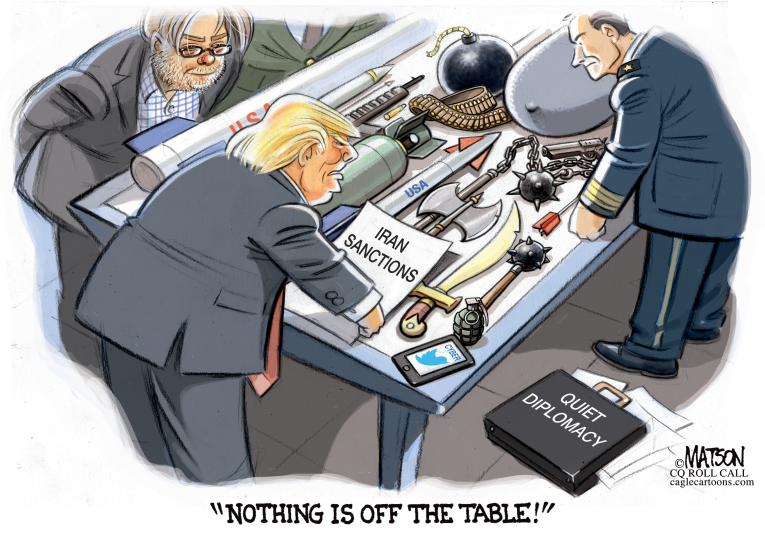
Image result for Donald Trump Iran Cartoon

The Trump administration has commenced with a tempest of policy implementation of promises made during the election campaign in areas of policy such as immigration, trade, health care, the Supreme Court, and many others. They mostly related to domestic policy and the American economy. Regarding the Middle East, the administration has adopted a different style of rhetoric from that of the previous administration. Nevertheless, there is no strong evidence for a new regional policy: whether in relation to Iran and the nuclear deal, the humanitarian catastrophe in Syria, or the issue of intensifying the war against ISIS and all forms of radical Islam. When shaping its Middle East policy in general and its policy on Iran in particular, the new administration will need to come to terms with major tensions within its policy targets—declared and undeclared—vis-à-vis Iran (regarding nuclear issues, regional influence, terror and subversion, long-range missile development, cyber warfare, and soft power) and other rivals (ISIS, Russia, China, North Korea). All of this must be dealt with under the guiding principle of “America first.”
This article expounds upon the proposed American policy vis-à-vis Iran, and the inputs that Israel can contribute to shaping this policy.

Where does Iran Challenge the United States?

US National Security Adviser Mike Flynn speaks during the daily press briefing at the White House in Washington, DC, on February 1, 2017. NICHOLAS KAMM / AFP
The first front on which Iran challenges the new American administration is that of the nuclear agreement. In response to Trump’s call during the campaign to reopen the July 2015 agreement between Iran and the P5+1, Iran declared that it is unwilling to do so. Recently, the Atomic Energy Organization of Iran even stated that it intends to input enriched material into advanced centrifuges (IR-8), in order to advance the research and development program of centrifuges that are more efficient than those currently used in Iran. The Iranian goals are to develop its technological ability to enrich uranium, to quickly amass fissile material, to reduce the size of installations required for future industrialized enrichment, and to make it easier to hide enrichment facilities should it choose to do so. This is not a blatant violation of the nuclear agreement, but rather “gray area” activity that depends on one’s interpretation of the agreement. Iran is attempting to force its interpretation, which naturally is more permissive than the American interpretation, and is testing American resolve to enforce the agreement in accordance with its own interpretation.
The second front pitting the Trump administration against Tehran appeared in the headlines this month thanks to a failed Iranian test of a North Korean-model ballistic missile, capable of carrying a nuclear warhead some 4000 kilometers. Although the United States and Germany declared that the test launch violated UN Security Council resolution 2231, this resolution does not unequivocally prohibit Iran from performing such a test, but “calls” for it not to carry out tests of ballistic missiles capable of carrying nuclear weaponry. Just as with the nuclear issue, Iran is not violating the resolution, but challenging it in practice and testing American willingness to respond. Furthermore, it has been reported that Iran tested a cruise missile capable of carrying a nuclear warhead. This action also does not violate the Security Council resolution, which does not relate to cruise missiles, but only ballistic missile tests.
The third front where Washington faces Tehran is in the non-nuclear realm. Iran works to expand its regional power against its main enemies—Israel and Saudi Arabia—by establishing militias and military proxies, as well as by providing Iranian weaponry and support to terror organizations. Against Israel, Tehran continues to support Hezbollah and supply it with advanced weapons, with the aim of enhancing its ability to threaten Israel. Iran also solidifies its power in Syria and Lebanon, including through ethnic cleansing of Sunni areas and settlement of Shiite populations in their stead, creating zones of Iranian influence. This is all undertaken while strengthening the alliance with Assad and Hezbollah.
Iran supports the Houthi rebel organizations fighting US allies in Yemen, Saudi Arabia, and the United Arab Emirates. Iran deals in subversion, destabilization, and terror among Shiite populations in the Gulf states, with a focus on northeastern Saudi Arabia and Bahrain. In the last few months, the conflict has even spread from land to sea: reports were published this week that Houthi forces attacked a Saudi ship in the Red Sea, killing two seamen. This follows the October 2016 attack by Houthi forces on a UAE ship, and the unsuccessful attempt to attack an American destroyer with Iranian surface-to-ship missiles. Generally, these attacks have been directed against US allies, not against American forces. On this front, too, Iran does not directly defy Washington, but aids the fight against its allies in an attempt to undermine the strength of the American-Sunni alliance in the Middle East.
From Iran’s perspective, this is merely a continuation of the cautious strategy of “testing boundaries” that was applied against the previous American administration. The Obama administration was determined to reach a deal with Iran regarding its nuclear program. For this purpose, it was willing to compromise on American interests and the interests of American allies while avoiding a significant escalation with Iran that could have endangered the administration’s diplomatic achievement in the nuclear issue. The assumption of the previous administration was that the alternative to an agreement was regional war, and that an agreement should be reached, even a non-optimal one, which should then be diligently implied.
Furthermore, it appears that Iran’s own self confidence has grown stronger due to Russian support and the increased cooperation between Tehran and Moscow since the signing of the Joint Comprehensive Plan of Action (JCPOA). Russia took advantage of the American passivity in Iraq and Syria in order to reassert its hold over the Middle East, finding a partner for this in Iran. Although this is not a strategic alliance, and there is mutual suspicion between Iran and Russia, both have made sure to successfully coordinate their actions in Syria, and to promote further common interests in preserving the Assad regime, expanding the supply of advanced Russian weaponry to Iran, and collaborating in the field of civil nuclear power.

American Resolve is required
In response to the ballistic missile test conducted by Iran, the Trump administration announced sanctions against Iranian organizations and persons connected with terror activities and the Iranian missile program. In addition, an American battleship was sent to the Bab el-Mandeb region to secure trade routes against Houthi rebels in Yemen, who are supported by Tehran. The objective of the American response, as stated by President Trump, was to refuse to show restraint in the face of problematic Iranian conduct and to deter the Iranian regime from continuing its wayward regional policy. Nevertheless, the statement by Defense Secretary James Mattis that he is not considering to increase American forces in the region shows that the new administration has yet to fully formulate a strategy that will significantly change the strategic reality vis-à-vis Iran as shaped by the Obama administration. Thus, the challenge facing the new American administration is, on the one hand, to block Iran on all the fronts where it is challenging the United States, while on the other hand to avoid escalation at an undesirable time.
The change in American rhetoric—as expressed in the statement of General Michael Flynn that Iran is “on notice,” and as reinforced by President Trump’s statement that Iran is “playing with fire”—was necessary to make clear to Iran that the rules of the game have changed. But words must be backed up by equivalent deeds that display the same level of force. The Trump administration should restore the credibility of American policies and declarations in order to deter Iran from taking negative policy steps, while strengthening Middle East stability and protecting the interests of the United States and its allies in the region.
In order to formulate a different policy on Iran, the Trump administration must confirm the following basic assumptions: a) rejection of the Obama administration’s assumption that there is no alternative to an agreement; this assumption paralyzed the previous administration. The new administration should start with an assumption that the alternative to an agreement is not necessarily war; b) the alternative to the existing agreement, should Iran pull out of it, is the restoration of significant sanctions and a credible military option. If Iran should move to nuclear breakout, the response should be a surgical military strike only against nuclear facilities and containment of the incident. Against a strong and determined administration, the possibility of escalation should scare Iran rather than the United States.
Based upon these decisions, it would be appropriate to define a strategy for two main time frames: the short-medium term, and the long term. In the short and medium terms, the Trump administration should work with other world powers to form a consensus regarding which actions by Iran would be considered a violation of the nuclear agreement. Even without Russian or Chinese agreement, the United States and its European allies should agree on interpretation and coordinate a response for the “gray area” violations. It should be clear that the United States, United Kingdom, France and Germany are committed to the agreement solely in accordance with a strict interpretation.
In parallel, Washington should push for a new Security Council resolution to replace Resolution 2231, which would unequivocally prohibit the test of Iranian ballistic and cruise missiles that can carry a nuclear warhead. Such actions would demonstrate—to both Iran and other world powers—American resolve to create new rules of the game.
Russia is a key country for implementation of this strategy. President Trump has stated that he intends to act in coordination with Russian president Vladimir Putin. In a future agreement between these leaders, it is essential to include a demand to weaken Iran’s hold in Syria, with a focus on Iranian deployment in southern Syria and the Golan Heights. Another important issue is the cessation of the supply of advanced Russian weaponry to Assad, and from him to Hezbollah rendering a direct threat against Israel.
Furthermore, the American administration should increase pressure on Iran’s alliances and relationships with terror organizations in the region, using counterterrorism and deterrence. This policy should include a joint intelligence effort of the United States and its regional allies, as well as Israel, along with the employment of targeted force aimed at stopping Iranian weapon deliveries by sea and air. Also in this arena, an aggressive policy against Iran’s system of alliances, and injury to the Quds Force, is necessary so that Tehran will understand that the Trump administration intends to deal with Iran and take risks not taken in the past by the United States.
The Trump administration seeks to make clear that it is not willing to permit provocative Iranian actions, but it is important to avoid uncontrolled escalation during the years when Iran is far from the nuclear threshold. The suggested strategy demonstrates that there is an alternative to an agreement, which will further regional stability while not lead to a regional war. For this purpose, it is important to avoid tactical and local responses, and to formulate a comprehensive strategy intended to weaken Iran.
Regarding the long-term, the American strategy should include preparatory plans with the aim of preserving the credibility of the American threat, even after some of the main restrictions on the Iranian nuclear program are removed, beginning at the end of the seventh year of the agreement. A major component of the strategy must be amending the agreement, which currently allows in the long term for Iran to become the legitimate, unrestricted owner of nuclear infrastructure. For this purpose, the US administration must create, together with its allies, deterrent and punishment mechanisms that will deter Iran from developing its nuclear program and approaching the nuclear threshold, and being a mere few months or weeks from a bomb. The enforcement mechanisms should also include the possibility—coordinated with the world powers that signed the agreement—of restoring a significant sanctions regime, which in the past led Iran to the negotiating table and to compromise.
The US administration should be ready for Iran to decide to withdraw from the agreement, or in the future to exploit the removal of restrictions as prescribed by the agreement and advance to nuclear weapons. Then, the ability to harm the Iranian economy’s financial and energy sectors and a credible threat of focused military force as a last resort to prevent a nuclear Iran will be a key to deter Iran. These deterrent mechanisms might be the only tools capable of preventing a nuclear Iran while also avoiding a large-scale regional military conflict.

The Israeli Input
For Israel, too, words must lead to deeds. Prime Minister Binyamin Netanyahu has declared that he intends to make the Iranian issue the main priority in the talks he will be holding with President Trump. Iran and its proxies, especially Hezbollah, are the greatest strategic threat currently facing Israel. Since summer 2015 we have been recommending an American-Israeli “parallel agreement” for coping with the consequences of the JCPOA and Iran’s malignant activities. Today there is an additional Israeli interest in establishing a strong regional front under American leadership against the extensive Iranian activities in the region. Formation of such a front would be a crucial and meaningful achievement for the stability of the Middle East and containment of Iran.
The formation of this type of regional anti-Iranian alliance may obligate Israel to make significant adjustments in the Palestinian issue. If President Trump would be willing to pursue bilateral agreements with his allies and perhaps even work towards convening a regional coalition with the participation of the United States, the Sunni Gulf states, and Israel, it is imperative that the Israeli government initiate moves that would not foil these efforts. This would be the optimal way to advance the most important Israeli interests in the long term against Iran while advancing an Israeli-Palestinian settlement. 

Thursday, May 5, 2016

Donald Versus Hillary ; 31% versus 69%..... will he close the lopsided polling gap... the largest in modern history


Donald Trump vs Hillary Clinton begins as most lopsided US election race of the modern era
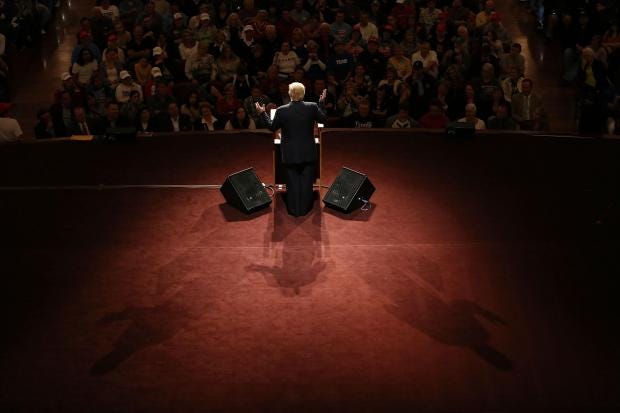
Mr Trump has effectively secured the Republican nomination - but can he beat Ms Clinton?


Trump is now a 98 per cent favourite to be the Republican nominee. Getty
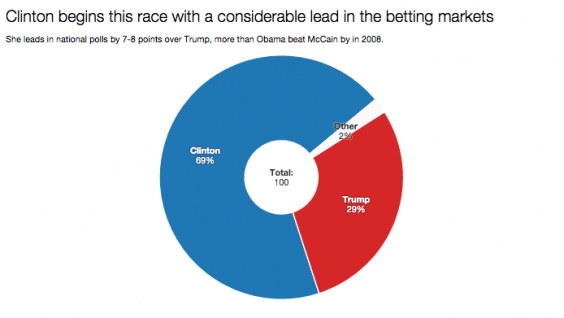

Donald Trump was the runaway winner in the Indiana primary, as expected. Polls, and the demographics of the state, had suggested as much. And as usual during this election, they’ve been proven right.

Less than three weeks ago, Mr Trump’s odds had fallen to 55 per cent. Now, he is as likely to be the Republican nominee as Hillary Clinton is to be the Democratic nominee, with both a 98 per cent favourite in the betting markets.

But the question remains: will he actually become President?

Now that he’s wrapped up the nomination, his chances of being America’s next president have shot up from 17 per cent to 29 per cent.

But that still makes Hillary Clinton a 69 per cent favourite (Mr Sanders or ‘some other Republican’ both have a 1 per cent chance).

Trump has ways to catch up.

That means Ms Clinton begins this six-month race more favoured than any other candidate in modern history: more than Mr Obama ever was against John McCain in 2008 or Mitt Romney in 2012, or George Bush was against Al Gore in 2000 and John Kerry in 2004.

Ms Clinton leads Mr Trump by 7-8 points in the 40 or so hypothetical general election polls published in the past six weeks. If she won by such a margin her victory would be at least as convincing as Mr Obama's in 2008.

Donald Trump: What are his actual policies??  You didn't really expect me to answer that question, I have absolutely no idea . Getting Mexico to build a Wall between them and the USA isn't Policy.... it is Silly Stupidity. Suggesting that Women are inferior to Men isn't Policy .... it is the the ramblings of an Ignorant Idiot. Trump and Policy statements are a Spin Doctors Worst Nightmare .

Yet a Donald Trump presidency is still a real possibility. A 3-in-10 chance is 1,450 times more likely than Leicester were to win the league this year - and we all know what happened there.

And those percentages will change rapidly if the national polls start to change, or if Mr Trump proves formidable in swing stateslike Florida – where he performed very strongly in the Republican primary – and across the ‘Rust Belt’ in places like Pennsylvania, Ohio and Michigan, where ‘white and working-class’ voters may swing behind him.

We just don’t know yet. The next six months are set to become one of the most contentious and aggressive political campaigns in history, between two figures who have each been in the limelight for more than 40 years.

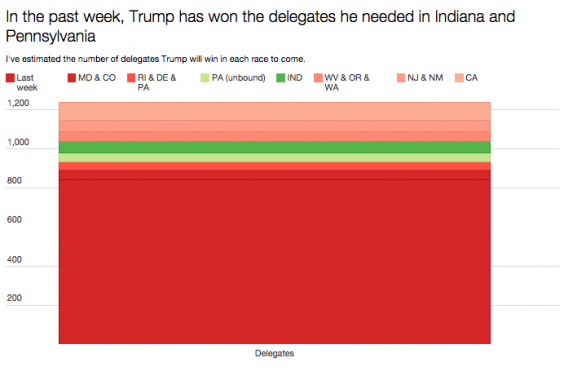
The primaries will drag on for another month (see here for an explanation of why Mr Trump has won, even though he’s still short of the 1237 delegates he needs), with California and a few other states effectively wrapping up each race on June 7.

Trump won tonight, as he did last week and the week before.

Then the race will turn quiet – in so far as a Mr Trump V Ms Clinton race ever could – until the conventions in late July, which now look increasingly unlikely to be contested.

Attention will be focused on who each candidate chooses to be their running mate, with Mr Trump purportedly short of options. Both will also try and unite their party, and ensure Mr Cruz or Mr Sanders supporters back them in the general election.

August could see fierce protests across the US as Mr Trump holds rallies that will surely be even larger and more fractious than those so far.

And in September and October the race reaches its final stretch, with three presidential debates over a fortnight (beginning on September 26).

America will finally vote on November 8.


A Timeline of Donald Trump’s Most Insane Insults on the Campaign Trail
A mock election.
by VH1 2/22/2016


Donald Trump faced repeatedly  with his political rivals in another comical Republican presidential debate. He loved the attention of  nightly attacks  from Senator Marco Rubio, who called “The Donald” out on his history of employing illegal immigrants, Trump was still able to throw some verbal haymakers at his opponents. Of course, this shouldn’t surprise anyone who has been following the race so far, as Trump has insulted pretty much everyone else who has crossed his path, from protestors to pundits, from his fellow candidates to the entire immigrant population. He even went at The Pope. If we were to list every insult he’s hurled on the campaign trail, we would be here all day. As often as most people eat and drink, Trump finds someone new to make fun of. And it’s done nothing but help him in the polls.

I’ve put together what we consider a representative sample of dozens of times that Trump has insulted his opponents, Democrats, oppressed groups, business leaders, and pretty much anyone else who he decided it was a good idea to go after. He’s insulted a lot of people this campaign season, though he still hasn’t insulted Kristen Stewart again since he announced. Hey there’s still time.

6/16/2015
Trump Announces His Presidential Bid

Target: Mexicans
“When Mexico sends its people, they’re not sending their best. They’re not sending you. They’re not sending you. They’re sending people that have lots of problems, and they’re bringing those problems with us. They’re bringing drugs. They’re bringing crime. They’re rapists. And some, I assume, are good people.”

Target: Barack Obama
“Obamacare really kicks in in 2016. Obama is going to be out playing golf. He might be on one of my courses. I would invite him, I actually would say. I have the best courses in the world, so I’d say, you what, if he wants to— I have one right next to the White House, right on the Potomac. If he’d like to play, that’s fine.”


Target: Ambassadors
“If you don’t have talented people, if you don’t have great leadership, if you don’t have people that know business, not just a political hack that got the job because he made a contribution to a campaign, which is the way all jobs, just about, are gotten, free trade terrible.”

Target: Secretary of State John Kerry
“And we won’t be using a man like Secretary Kerry that has absolutely no concept of negotiation, who’s making a horrible and laughable deal, who’s just being tapped along as they make weapons right now, and then goes into a bicycle race at 72 years old, and falls and breaks his leg. I won’t be doing that. And I promise I will never be in a bicycle race. That I can tell you.”

Trump came out swinging with these and a number of other insults setting the tone for his campaign. He also began the racial fear mongering that has been a hallmark of his time on the trail. The man has been nothing if not consistent.

6/23/15


Target: Jeb Bush
“I can’t believe Bush is in first place. This guy can’t negotiate his way out of a paper bag. So I’m in second place to Bush? I hate it!”

Well, as you all know, Bush isn’t in first place anymore. However, that hasn’t stopped Trump from continuing to take shots at him.

6/28/15
Target: Immigrants in General
“I’m talking about people that are from all over that are killers and rapists and they’re coming into this country.”

In an attempt to clarify comments about Mexican immigrants, Trump went and made things worse.

7/8/15


Target: Hillary Clinton
“Hillary Clinton was the worst Secretary of State in the history of the United States.”


7/16/15
Target: Magician Penn Jillette

Who knew Trump had it out for magicians? Maybe he’s just more of a Criss Angel guy.

7/18/15
Target: Sen. John McCain
“He’s not a war hero. He was a war hero because he was captured. I like people who weren’t captured.”

Few things that Trump has said have resulted in a sustained backlash. It seems no matter what he says, his supporters become more adamant and his poll numbers continue to rise. This one touched a nerve, though it didn’t affect his standing in the race. Trump himself received four deferments between 1964 and 1968 to avoid military service.

7/21/15
Target: Rick Perry (Former Governor of Texas)
“He put on glasses so people think he’s smart. People can see through the glasses.”

Trump has since attacked Jeb Bush for no longer wearing glasses, so it’s hard to tell where he stands on eyewear.

7/21/15
Target: Lindsay Graham
“You have this guy Lindsey Graham, a total lightweight — here’s a guy, in the private sector, he couldn’t get a job.”


7/21/15
Target: “The Press”
“The press is very dishonest.”

8/7/15
Target: Megyn Kelly
“You could see there was blood coming out of her eyes. Blood coming out of her wherever.”

Trump said this after Kelly pressed him on misogynistic comments he’s made in the past. When you know you’re in the wrong, why not double down on that wrongness?

8/9/15
Target: Carly Fiorina

8/11/15
Target: Bernie Sanders
“I thought that was disgusting. That showed such weakness, the way he was taken away by two young women. That will never happen with me. I don’t know if I’ll do the fighting myself, or if other people will, but that was a disgrace.”

Trump had this to say about Bernie Sanders after he allowed two women representing the Black Lives Matter movement to air their grievances at one of his rallies. Sanders has since incorporated many concerns of the Black Lives Matter movement into his platform. Trump … has not.

8/12/15
Target: Rand Paul
“Recently, Rand Paul called me and asked me to play golf. I easily beat him on the golf course and will even more easily beat him now, in the world in the politics.”


9/9/15
Target: Carly Fiorina
“Look at that face! Would anyone vote for that? Can you imagine that, the face of our next president?! I mean, she’s a woman, and I’m not supposed to say bad things, but really, folks, come on. Are we serious?”

Trump hurled this insult at a television screen once Carly appeared. According to Rolling Stone reporter Paul Solotaroff, the lackeys on his campaign staff immediately began laughing along with him.

9/16/15
Target: Rand Paul
“I never attacked him on his look[s], and believe me, there’s plenty of subject matter right there.”

9/16/15
Target: President Barack Obama
“Somehow [Obama] just doesn’t have courage. There is something missing from our president,”

9/23/15
Target: Hillary Clinton
“Do you know the word ‘shrill’? She can be kind of sha-riiiiiillllll!”

9/23/15
Target: Chris Christie
“That room was hot. I mean, poor Chris Christie!” he said. After some gasps and laughter, Trump said, “No, it’s true.”

9/25/15
Target: Sen. Marco Rubio
“You have this clown, Marco Rubio, I’ve been so nice to him.”


10/25/15
Target: Ben Carson, Seventh-Day Adventists
“I mean, Seventh-day Adventist, I don’t know about, I just don’t know about.”

Trump broke with his usual character here, making fun of a religion that wasn’t Islam

10/28/15
Target: John Kasich
“This is the man that was a managing general partner at Lehman Brothers, when it went down the tubes, and almost took every one of us with us, including Ben and myself. Because I was there, and I watched what happened, and Lehman Brothers started it all. He was on the board, and he was a managing general partner.”

As you probably guessed, no, Kasich was not on the board of Lehman Brothers. However, it is worth mentioning that Kasich does have ties to Lehman Brothers.

11/2/15
Target: Sen. Marco Rubio
“[Rubio] is the one that sweats the most. He’s the youngest but I have never seen any human being sweat like that.”

This was one of Trump’s pet talking points last Fall. He mentioned Rubio’s sweat on Bloomberg TV in November, after trotting out the insult on September 23rd, 24th, and on October 5th at various campaign stops.

11/12/15
Target: Ben Carson
“It’s in the book that he’s got a pathological temper. That’s a big problem because you don’t cure that. As an example: child molesting. You don’t cure these people.”

11/12/15
Target: People of Iowa
“How stupid are the people of Iowa?”

The question was, of course, rhetorical.

11/18/15
Target: Heckler at Rally in Worchester, Mass.
“You know, it’s amazing. I mentioned food stamps and that guy who’s seriously overweight went crazy. He went crazy. It’s amazing.”

11/22/15
Target: Hillary Clinton


11/25/15
Target: New York Times Reporter Serge F. Kovaleski, Disabled People in General
“Now the poor guy, you ought to see this guy. ‘Ah, I don’t know what I said! I don’t remember!’”

Trump accompanied this remark with crude gestures obviously mocking Kovaleski’s disability.

12/6/15
Target: Oval Office Podium

12/18/15
Target: Jeb Bush

12/22/16
Target: Hillary Clinton
“Everything that’s been involved in Hillary has been losses, you take a look. Even her race to Obama, she was going to beat Obama…I don’t know who’d be worse. I don’t know. How does it get worse? She was going to beat, she was favorite to beat and she got schlonged. She lost, I mean she lost.”

Trump is so colorful with his insults, sometimes he pulls out an obscure word that no one has heard since 1940 that is perfect for making everyone hate him that much more.

1/6/16
Target: Samuel L. Jackson

Shortly after the New Year, Trump took some time away from his campaign to exchange barbs with the Hateful Eight star regarding their golf games.


1/20/16
Target: Jeb Bush
“He can’t fix anything. He’s a low energy person. Low energy people don’t get things fix.”

Wolf Blitzer made Jeb sit through a minute of Trump’s insults while they held on a close-up of him. LOL.

1/22/16
Target: Jeb Bush

1/27/16
Target: Megyn Kelly

2/7/16
Target: Marco Rubio
“So I have him here. I have Marco, honestly Marco was having a hard time. And he’s a nice guy, he’s a nice guy. I mean, again and again and again. After 3 times, you know I have a very good memory. And after 3 times I said, wait a minute, he said that about 3 minutes ago.”

Trump took this shot at Rubio after his repetitive debate performance became the talk of DC, and led to a sharp slide down the polls in New Hampshire.


2/8/16
Target: Ted Cruz
“Okay, you’re not allowed to say and I never expect to hear that from you again. She said — I never expect to hear that from you again! — she said: ’He’s a pussy.’ That’s terrible.”

With this one, Trump used that old school yard trick of repeating an insult. Hey, he didn’t technically say it! We look forward to later debates when he may finally employ the “I’m rubber, you’re glue” defense.

2/15/16
Target: Ted Cruz
“This guy, Ted Cruz, is the most dishonest guy I think I’ve ever met in politics.”

2/18/16
Target: Pope Francis
“No leader, especially a religious leader, should have the right to question another man’s religion or faith. They are using the Pope as a pawn and they should be ashamed of themselves for doing so, especially when so many lives are involved and when illegal immigration is so rampant.”

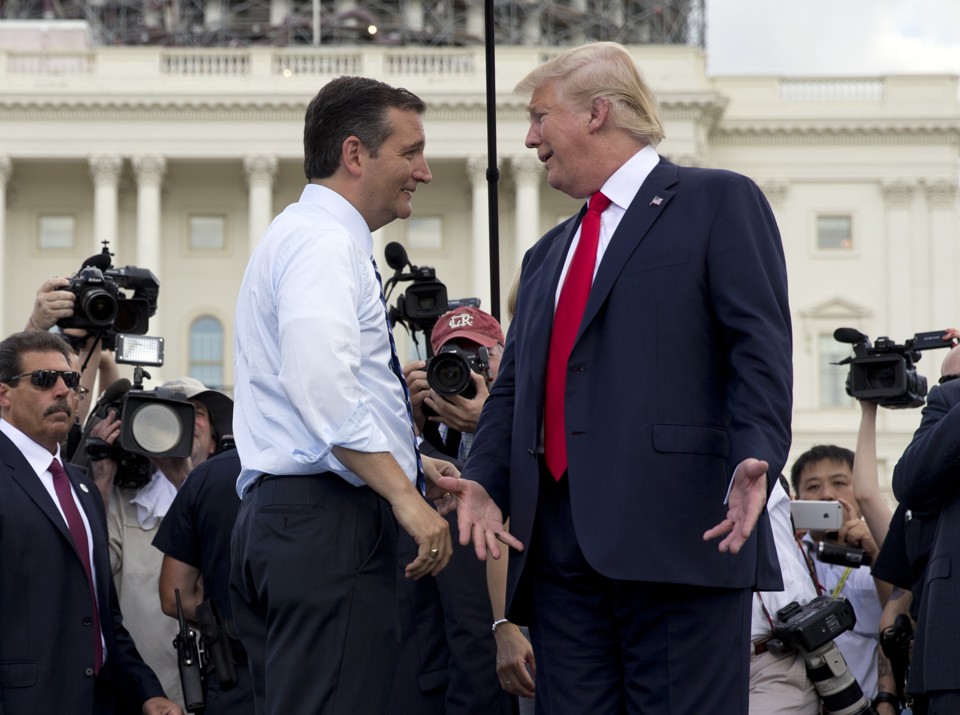
This is a small excerpt from a longer statement that Trump issued following the Pope’s proclamation that “A person who thinks only about building walls, wherever they may be, and not building bridges, is not Christian,” while visiting Mexico.Aside from calling the Florida Senator a “choke artist” Trump has an issue with how much Rubio perspires. In a post debate interview Trump aided concerns about effective Rubio would be in diplomatic affairs because of his sweat issue. Catch it at the 2:44 mark.

Now that he’s tackled the Pope and all of the above, he pretty much only has God and his very own supporters left to mock before he alienates the entirety of the world.Why do we feel like both those insults will happen before election day?